




Introduction
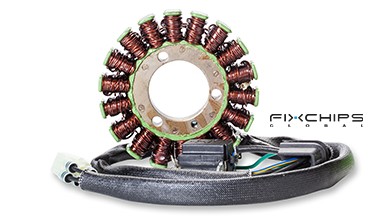
A stator is the stationary part of an electric motor or generator. It helps create a magnetic field and supports the conversion of electrical and mechanical energy.
This guide explains how stators work, compares common types, and covers their materials, cooling methods, testing, and maintenance.
What Is a Stator?
A stator is the fixed component inside an electric machine that remains completely still during operation. It creates a magnetic field that interacts with the rotating inner part.
It works by running electrical current through wire coils wrapped around a metal core. This component is widely used in home appliances, electric cars, industrial motors, and power generators.
Structure of a Stator
A stator's parts depend on its design, but many wound stators share several basic components.
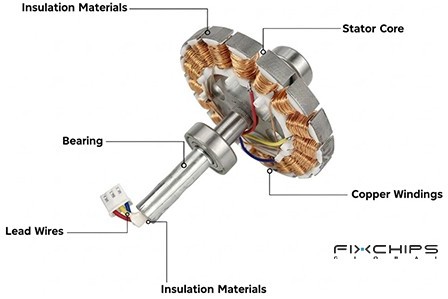
- Stator core: Made from stacked magnetic steel sheets in many designs. It guides magnetic flux and helps reduce losses.
- Slots: Openings in the core that hold the windings.
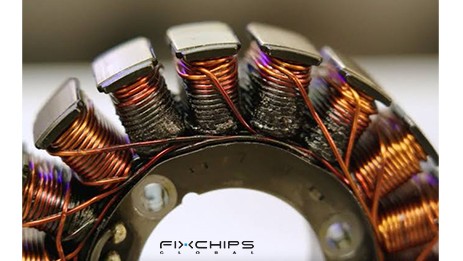
- Windings: Conductive wires, usually copper or sometimes aluminum, that carry current and produce a magnetic field.
- Insulation: Separates the windings from the core and from other conductors to prevent unwanted current flow.
- Stator frame or housing: An outer metal housing that protects internal parts and keeps the unit rigid.
- Terminals and lead wires: Connect the windings to the power supply or control circuit.
How Does a Stator Work?
A stator works by creating or guiding a magnetic field that interacts with the rotor or supports electrical generation.
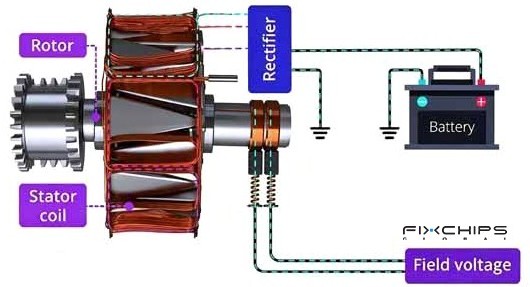
1. Receive Electrical Power: The windings receive current from a power supply or motor controller.
2. Create a Magnetic Field: Current flowing through the windings produces a magnetic field.
3. Shape the Magnetic Field: The stator core guides the magnetic flux through the intended magnetic path.
4. Interact with the Rotor: In a motor, the stator field interacts with the rotor's magnetic field or induced currents to produce torque.
5. Produce Rotation: The rotor turns, transferring mechanical power to a shaft or connected load.
6. Release Heat: Heat from the windings and core moves into the frame or cooling system.
Stator vs. Rotor
The stator stays in place while the rotor turns. Together, they form the main electromagnetic parts of many motors and generators.
| Feature |
Stator |
Rotor |
|
Position |
Fixed to the machine frame |
Located inside or around the stator |
|
Movement |
Fixed during normal operation |
Rotates during normal operation |
|
Function |
Creates or guides a magnetic field |
Produce or receive mechanical power |
|
Role in operation |
Provides a stationary magnetic or electrical structure |
Transfers rotational motion through the shaft or rotating assembly |
|
Electrical connection |
Connect directly to the power supply or output circuit |
May carry induced current or field current |
|
Application |
Motors, generators, alternators |
Motors, generators, alternators |
Types of Stators
Stators can be classified by their power supply, physical design, winding arrangement, number of phases, and magnetic materials. Each type has a different structure or operating feature for specific applications.
By Supply Current
AC Stator
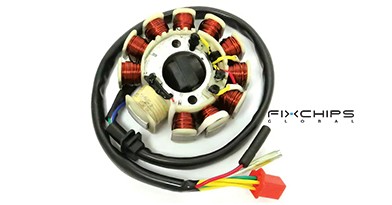
An AC stator uses windings supplied with alternating current to create a changing magnetic field. It is widely used in AC motors, industrial pumps, fans, and generators.
DC Stator
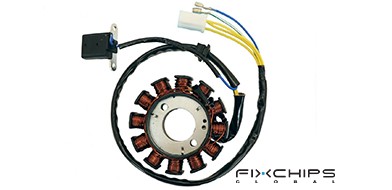
A DC stator uses field windings supplied with direct current or permanent magnets to provide a magnetic field. It is used in DC motors and generators, including brushed motors and some battery-powered systems.
AC Stator vs. DC Stator
|
Comparison |
AC Stator |
DC Stator |
|
Power Supply |
Alternating current (AC) |
Direct current (DC) |
|
Magnetic Field |
Produces a rotating magnetic field |
Produces a fixed magnetic field |
|
Winding Purpose |
Creates the rotating magnetic field |
Creates the main magnetic field |
|
Speed Control |
Controls speed by changing supply frequency |
Controls speed by changing supply voltage |
|
Starting Method |
Uses a direct AC supply |
Uses a DC supply |
|
Efficiency |
Low energy loss in modern designs |
Low energy loss in modern designs |
|
Maintenance |
Winding and insulation checks |
Winding and insulation checks |
|
Applications |
Industrial motors, pumps, and fans |
DC motors, electric tools, and battery-powered equipment |
By Physical Design
Salient Pole Stator
A salient-pole structure has clearly projecting magnetic poles, which shape the magnetic field across the air gap. However, salient poles are more commonly a feature of rotors in synchronous machines, while the stator usually contains a slotted core and windings.
Cylindrical Stator
A cylindrical stator has a round core or housing that supports the internal components and helps maintain a consistent shape around the rotor. This form is used in many industrial motors and generators, although cylindrical more commonly describes rotor design when classifying synchronous machines.
By Winding Arrangement
Distributed Winding Stator
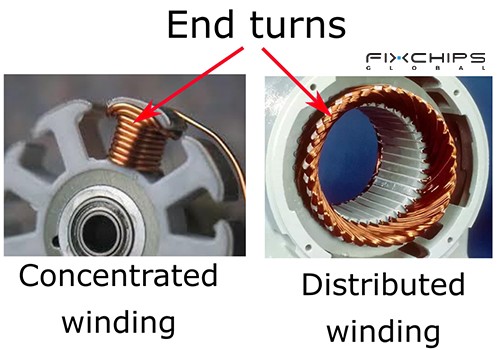
A distributed-winding stator spreads its coil sides across several slots around the core, creating a more evenly distributed magnetic field. It is commonly used in AC motors and generators.
Concentrated Winding Stator
A concentrated-winding stator places each coil around one tooth or a small group of teeth, making the winding layout more compact. It is used in various brushless motors and compact motor designs.
By Number of Phases
Single-Phase Stator
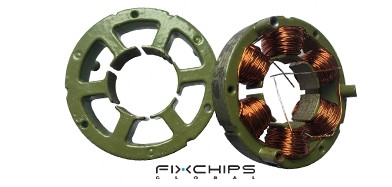
A single-phase stator has windings designed for a single-phase AC supply and may include auxiliary windings to help start the motor. It is common in household appliances, small pumps, and fans.
Three-Phase Stator
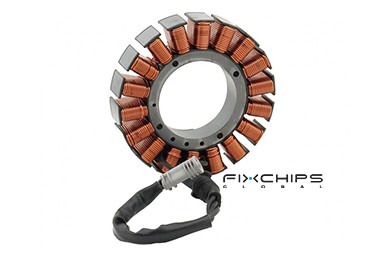
A three-phase stator has windings arranged in three electrical phases to create a rotating magnetic field. It is widely used in industrial motors, compressors, pumps, and other high-power equipment.
Multi-Phase Stator
A multi-phase stator uses more than three electrical phases, with windings arranged to produce controlled magnetic fields and torque. It is used in some advanced electric drives, traction systems, and applications that need smooth operation or fault tolerance.
Special Types
Permanent Magnet Stator
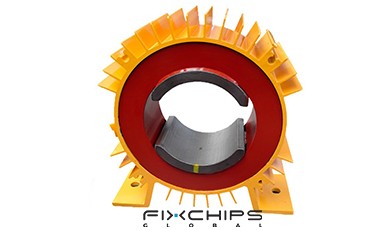
A permanent-magnet stator uses fixed magnets instead of energized field windings to produce a magnetic field. It is found in certain specialized motors and magnetic-drive designs, although many common permanent-magnet motors place their magnets on the rotor.
Amorphous Metal Stator
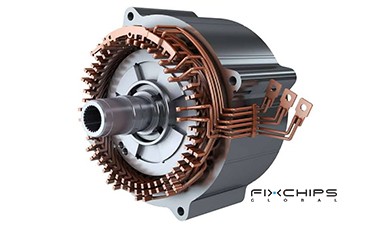
An amorphous-metal stator uses a core made from metal with a non-crystalline structure, which can reduce magnetic core losses. It may be used in energy-efficient motors and other electrical machines where lower core losses are important.
Pole-Changing Stator
A pole-changing stator uses windings that can be connected in different ways to change the number of magnetic poles. It is used in some AC motors to provide different operating speeds without relying solely on a variable-frequency drive.
Modern Improvements in Stator Technology
Modern stator design focuses on reducing energy loss, improving cooling, increasing power density, and making production more consistent. Material choices, manufacturing methods, and winding designs all affect these goals.
Innovative Materials
- Electrical steel: Thin steel sheets guide magnetic flux. Laminated cores help reduce eddy-current losses and are widely used in motors and generators.
- Copper: Copper windings offer high electrical conductivity. They are common in motors that need low winding resistance.
- Aluminum: Aluminum is lighter than copper and can reduce conductor weight. Its lower electrical conductivity means that conductor size and design must be considered.
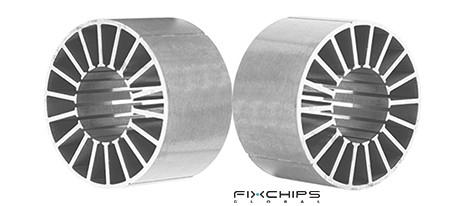
- Amorphous metal: Some amorphous alloys have low magnetic core losses. They may suit applications where energy loss is a key concern, but manufacturing and cost can limit their use.
- High-temperature insulation: Heat-resistant insulation helps protect windings under demanding thermal conditions. The correct insulation class depends on the motor's design and operating temperature.
- Advanced thermal materials: Thermally conductive materials can help move heat away from windings or other hot areas. Their usefulness depends on electrical insulation, temperature limits, and the cooling layout.
Manufacturing Technology
3D printing can produce complex shapes that are difficult to make with traditional machining or assembly. For stators, it can support customized cooling channels, prototypes, and designs that combine several functions into one part.
For example, a printed stator component may include channels that bring coolant closer to the windings. This can improve heat removal when the design and coolant flow are suitable.
Winding Technology
- Hairpin winding: Uses shaped rectangular conductors instead of only round wire. It supports automated production and high copper fill in many traction motors, but its AC losses need attention at high speeds.
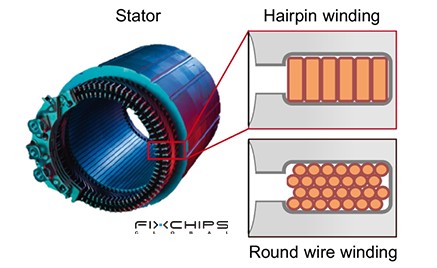
- Form-wound coils: Coils are shaped before installation into the stator slots. This helps control coil dimensions and is common in larger electrical machines.
- Segmented or modular windings: Separate winding sections are assembled into a stator. This can simplify some manufacturing and repair tasks, depending on the design.
Applications of Stators
- Industrial motors
Stators create magnetic fields that drive pumps, fans, conveyors, and production equipment.
- Electric vehicles
Traction-motor stators help convert electrical energy from the battery into mechanical power.
- Generators
Stator windings produce electrical output when the magnetic flux through them changes.
- Wind turbines
Generator stators convert the generator's electromagnetic action into electrical output.
- Rail transport
Traction-motor stators help produce the force needed to move trains.
- Robotics
Stators work with rotors to provide controlled movement in robotic joints and actuators.
Stator Cooling Methods
Stator windings and cores produce heat during operation. If the heat is not removed, high temperatures can damage insulation and shorten service life. The cooling method depends on the machine's power, size, and operating conditions.
- Natural air cooling: Heat moves into the surrounding air without a dedicated cooling fan; it suits some small or low-power machines.
- Forced-air cooling: A fan moves air over the stator or through ventilation passages; it is common in many industrial motors.
- Liquid-jacket cooling: Water-based coolant flows through channels in the housing around the stator; it is used in designs that need stronger heat removal.
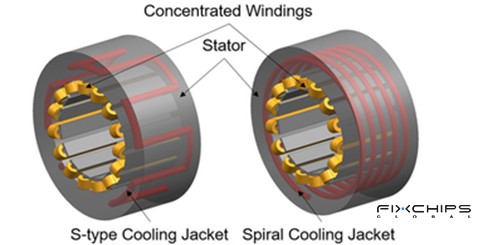
- Direct liquid cooling: Coolant passes through channels close to the windings or other hot areas; it suits selected high-power-density motors.
- Direct oil cooling: Oil is directed onto the stator core or windings to carry heat away; it is used in some traction-motor designs.
- Internal ventilation channels: Air or another cooling medium flows through designed passages in the stator assembly; this helps remove heat from internal regions.
- Heat-pipe cooling: A sealed device transfers heat through evaporation and condensation of a working fluid; it can be used in specialized thermal designs.
How to Test a Stator
Stator testing helps identify winding faults, insulation damage, and connection problems before they cause more serious failures. The exact tests depend on the machine and the manufacturer's instructions.
|
Step |
Description |
Tip |
|
1. Disconnect Power |
Isolate the machine from every power source before testing. |
Follow lockout and safety procedures. |
|
2. Inspect the Stator |
Check for burnt areas, damaged insulation, loose connections, and signs of overheating. |
Look for unusual smells, discoloration, or debris. |
|
3. Check Winding Resistance |
Use a suitable multimeter or low-resistance meter to measure the winding resistance. |
Compare equivalent phases or circuits where applicable. |
|
4. Test Insulation Resistance |
Use an insulation resistance tester to check insulation between windings and ground, as required. |
Select the test voltage according to the machine's rating and approved procedure. |
|
5. Compare Phase Readings |
Compare resistance readings between equivalent phases in a multiphase winding. |
A large difference may indicate a fault, but temperature and winding design also matter. |
|
6. Check Connections |
Confirm that terminals and winding connections match the wiring diagram. |
Look for loose, corroded, or damaged connections. |
|
7. Review Results |
Compare measurements with manufacturer limits and suitable test standards. |
Do not rely on one test to rule out every fault. |
Common Stator Problems and Solutions
Stator faults can result from overheating, electrical stress, moisture, vibration, or poor connections. The right solution depends on the cause and the condition of the winding and core.
Overheating
▶ Cause: Overloading, blocked air passages, or a failed cooling fan.
▶ Solution: Reduce the load, clean the air passages, or replace the faulty fan.
Insulation Failure
▶ Cause: Excessive heat, moisture, or damaged insulation.
▶ Solution: Dry the winding if it is damp, repair minor insulation damage where permitted, or rewind the stator if the insulation is severely damaged.
Shorted Windings
▶ Cause: Damaged insulation allows current to flow between winding turns.
▶ Solution: Confirm the fault with a winding test, then rewind or replace the stator if the short is confirmed.
Open Winding
▶ Cause: A broken wire or disconnected winding lead interrupts the circuit.
▶ Solution: Repair the broken lead or connection; rewind the stator if the break is inside the winding.
Uneven Phase Resistance
▶ Cause: A loose terminal, poor connection, or damaged winding creates resistance differences between phases.
▶ Solution: Tighten or repair loose connections, then retest the windings; rewind the stator if the winding is damaged.
Moisture Damage
▶ Cause: Water ingress or condensation reduces insulation resistance.
▶ Solution: Find and seal the source of moisture, dry the stator using an approved method, and test the insulation before restarting.
Excessive Vibration
▶ Cause: Loose mounting bolts, rotor imbalance, or worn bearings
▶ Solution: Tighten the mounting bolts, balance the rotor, or replace worn bearings as required.
Abnormal Noise
▶ Cause: Loose components, bearing damage, or contact between rotating and stationary parts.
▶ Solution: Secure loose components, replace damaged bearings, and inspect the rotor and stator for contact marks.
Core Damage
▶ Cause: Damaged core laminations or failed insulation between them increases local heating.
▶ Solution: Inspect the damaged area, repair the core using a suitable motor-repair method, or replace the stator if the damage is severe.
How to Maintain Stators
Regular maintenance helps detect early signs of damage, reduce unexpected downtime, and extend equipment service life.
1. Inspect the exterior:
Look for damage, corrosion, loose fasteners, and signs of overheating.
Tools: Flashlight and basic inspection tools.
2. Clean the stator area:
Remove dust and debris using a method approved for the machine.
Tools: Suitable vacuum, soft brush, and approved cleaning supplies.
3. Check cooling passages:
Make sure air passages are clear and cooling systems operate as intended.
Tools: Flashlight and, where needed, approved airflow or temperature instruments.
4. Inspect electrical connections:
Check terminals, cables, and accessible connections for looseness or damage.
Tools: Insulated hand tools and suitable inspection equipment.
5. Measure winding resistance:
Compare readings with earlier records or manufacturer limits when the machine is safely isolated.
Tools: Multimeter or low-resistance meter.
6. Check insulation condition:
Test insulation resistance at the required intervals and under the correct conditions.
Tools: Suitable insulation resistance tester operated by qualified personnel.
7. Monitor temperature and vibration:
Record operating conditions to help identify changes over time.
Tools: Appropriate temperature and vibration instruments.
8. Record maintenance results:
Keep inspection findings, measurements, repairs, and test dates for future comparison.
Tools: Maintenance log or digital record system.
Frequently Asked Questions
What does a stator do?
A stator creates or guides a magnetic field in an electric motor. In a generator, its windings can produce electricity when the magnetic field changes.
Can a motor work without a stator?
No. A conventional electric motor needs a stator or an equivalent stationary magnetic structure to interact with the rotor and produce torque. Without this part, the motor cannot operate as designed.
What are the signs of a faulty stator?
Common signs include overheating, a burning smell, unusual noise, poor motor performance, or low electrical output. These symptoms do not prove the stator is faulty, so electrical tests are needed to confirm the cause.
How long does a stator last?
A stator has no single fixed service life. Its lifespan depends on operating temperature, electrical load, insulation quality, cooling, and maintenance.
Can a damaged stator be repaired?
Yes. Repair options include fixing damaged connections, repairing suitable insulation faults, or rewinding damaged coils. If the core or windings are severely damaged, replacing the stator may be the better option.
Does a stator produce AC or DC?
A stator can be part of a machine that uses AC or DC. In many generators, the stator windings produce AC, which can then be converted to DC by a rectifier when DC output is needed.


