



Introduction
An alternating current (AC) filter is a circuit that controls unwanted frequency components in an AC signal or power line. It usually uses components such as resistors, capacitors, and inductors to reduce noise and allow the needed part of the signal to pass.
This article explains what AC filters do, how they work, their main types, applications, manufacturers, selection points, and basic maintenance.
What Is an Alternating Current Filter?
An alternating current filter is a circuit designed to pass desired AC frequency components while reducing unwanted ones. It is used to reduce electrical noise, interference, and other unwanted frequency components in electronic and power systems.
AC filters were developed to make electrical signals and power systems cleaner and more stable. Today, filter circuits are used in consumer electronics, industrial equipment, communication systems, power supplies, and other electrical equipment.
Why Is an Alternating Current Filter Important?
As switching frequencies increase and electronic equipment becomes more compact and densely packed, unwanted AC noise becomes harder to ignore. Without suitable filtering, electrical signals can contain unwanted components that may affect circuit operation.
Electrical noise and harmonic distortion may cause many problems:
- Signal interference
- Unstable circuit operation
- Communication errors
- Electromagnetic interference
- Reduced equipment reliability
- Power quality problems
Function of Alternating Current Filters
The main functions of an AC filter include:
- Reducing unwanted electrical noise.
- Blocking or reducing selected frequency components.
- Allowing the required frequency range to pass.
- Reducing electromagnetic interference (EMI).
- Improving signal quality.
- Helping electronic equipment operate with less interference.
Working Principle of Alternating Current Filters
Main Components
Before looking at how an AC filter works, it is useful to understand three basic components: the resistor, capacitor, and inductor.
- Resistor: A resistor limits current and can also control the relationship between voltage and current in a filter circuit.
- Capacitor: A capacitor stores electrical energy and has frequency-dependent impedance. In many filter circuits, it provides a path for selected AC frequency components.
- Inductor: An inductor stores energy in a magnetic field and resists changes in current. Its impedance increases with frequency, which allows it to reduce some higher-frequency components.
Working Principle
An AC filter works by using the frequency-dependent behavior of its components. The basic process can be understood in several steps:
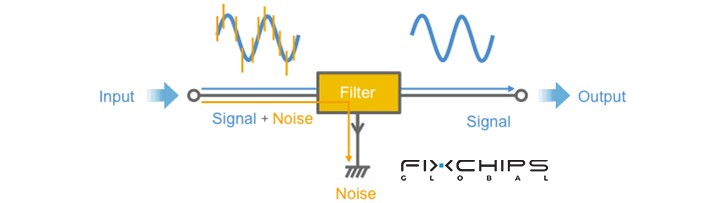
1. The AC signal enters the filter
The input contains the required electrical signal as well as unwanted frequency components. The filter receives both at the same time.
2. The components respond differently to frequency
The capacitor and inductor do not react to all frequencies in the same way. Their electrical impedance changes with frequency, so they can be arranged to reduce selected components.
3. Unwanted frequencies are reduced
Depending on the circuit design, unwanted frequencies may be directed through a capacitor, opposed by an inductor, or reduced by a combination of components.
4. The required signal continues to the load
After filtering, the desired frequency range remains available to the next part of the circuit, while unwanted components are attenuated.
Types of Alternating Current Filters
Different AC filters are designed for different frequency ranges. The main types include low-pass, high-pass, band-pass, band-stop, EMI, and AC line filters.
Low-Pass Filter
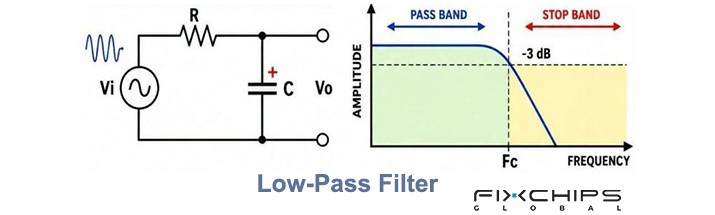
A low-pass filter allows frequencies below its cutoff frequency to pass while reducing higher-frequency components. It is commonly used when a useful low-frequency signal needs to be kept while higher-frequency noise is reduced.
High-Pass Filter
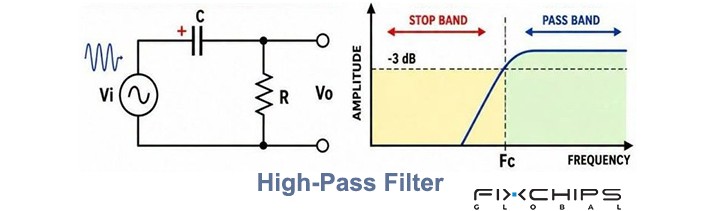
A high-pass filter allows frequencies above its cutoff frequency to pass while reducing lower-frequency components. It can be used when a higher-frequency signal is needed and lower-frequency components are unwanted.
The cutoff frequency determines the transition between the frequencies that are mainly reduced and those that are mainly passed.
Band-Pass Filter
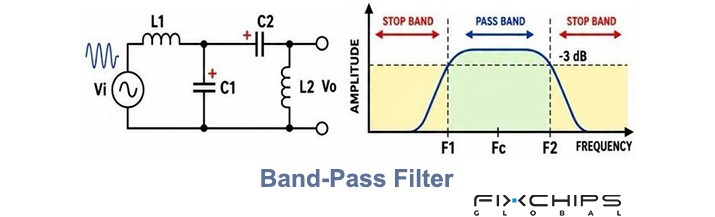
A band-pass filter allows a selected range of frequencies to pass while reducing frequencies below and above that range. It is useful when only a specific frequency band is required.
Its operation is commonly achieved by combining filtering characteristics that remove frequencies outside the desired band.
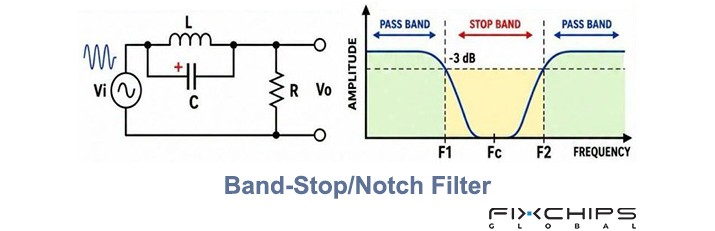
Band-Stop / Notch Filter
A band-stop filter, also called a notch filter, reduces a selected range of frequencies while allowing frequencies outside that range to pass.
A notch filter can therefore be useful when a particular unwanted frequency needs to be strongly reduced without blocking the rest of the signal.
EMI Filter
An EMI filter is designed to reduce electromagnetic interference. It can reduce unwanted electrical noise that travels through signal or power paths.
Common EMI filter designs include capacitive filters, ferrite-based filters, common-mode chokes, and LC filters.

AC Line Filters
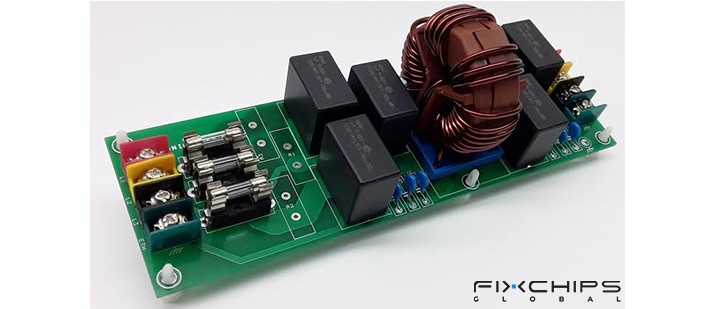
An AC line filter is connected to an AC power line to reduce unwanted conducted noise. It is commonly used at the power input of electronic and electrical equipment.
AC line filters are available for single-phase and three-phase systems. Their selection depends on factors such as rated voltage, current, noise characteristics, leakage current, and the required level of attenuation.

Comparison of AC Filter Types
|
Filter Type |
What It Passes |
What It Rejects |
Applications |
|
Low-Pass Filter |
Lower frequencies |
Higher frequencies |
Signal conditioning, noise reduction |
|
High-Pass Filter |
Higher frequencies |
Lower frequencies |
Signal coupling, removal of low-frequency components |
|
Band-Pass Filter |
A selected frequency band |
Frequencies below and above the band |
Communication and signal processing |
|
Band-Stop / Notch Filter |
Frequencies outside the stop band |
A selected frequency range |
Removing specific unwanted frequencies |
|
EMI Filter |
Desired electrical components |
Unwanted electromagnetic noise |
Electronic equipment and power systems |
|
AC Line Filter |
Required AC power components |
Conducted noise and unwanted high-frequency components |
Power supplies, industrial equipment, electronic equipment |
Manufacturers of Alternating Current Filters
Several established electronic component and EMC manufacturers offer AC, EMI, or power-line filtering products. Their product ranges and designs vary by application.
TE Connectivity / Schaffner
Schaffner is part of TE Connectivity and provides EMC and power-quality products. Its portfolio includes single-phase and three-phase power-line filters for areas such as industrial machinery, robotics, medical equipment, EV infrastructure, and energy systems.
TDK
TDK offers power-line EMC filters for single-phase, three-phase, and DC applications. Its product range includes general-purpose filters, pulse-attenuation filters, high-attenuation designs, and common-mode chokes.
Murata
Murata provides a broad range of EMI suppression products, including LC low-pass filters, ferrite beads, common-mode chokes, and other noise-suppression filters. Its products are designed for different signal and power-line noise problems.
Delta Electronics
Delta Electronics offers power-line filter products for electrical and industrial applications. Its filter portfolio includes EMC/EMI line-filter modules, including single-phase and three-phase designs.
SCHURTER
SCHURTER provides power-entry modules and line filters for electronic equipment. Its filter products include integrated EMI filtering, different mounting options, and versions for standard and medical equipment.
Applications of Alternating Current Filters
AC filters are used in many areas because unwanted electrical noise can occur in both small electronic devices and large industrial systems.
Everyday Electronics
- Computers and monitors: AC line filters can reduce conducted noise entering or leaving equipment through the power connection.
- Televisions and home entertainment equipment: Filters can help reduce unwanted electrical interference in power and signal paths.
- Household appliances: AC filters can help control conducted electromagnetic noise generated by switching circuits and other electronic parts.
- Power adapters: EMI filtering can reduce unwanted high-frequency noise associated with switching power conversion.
Industrial Uses
- Industrial power supplies: AC line filters can reduce conducted noise on power input and output paths.
- Motor drives: Filters can help control electromagnetic noise produced by switching power electronics.
- Inverters: AC filters can reduce unwanted noise associated with high-speed switching.
- Industrial machinery: Filters can help improve electromagnetic compatibility between equipment and the surrounding electrical system.
Industrial Automation
- PLC systems: Filters can reduce unwanted electrical noise that may affect sensitive control electronics.
- Servo systems: Filtering can help control conducted interference in systems containing switching power electronics.
- Automation controllers: AC filters can reduce unwanted noise entering through the power supply.
- Factory control equipment: Filters can help limit conducted interference between connected equipment.
Medical and Sensitive Equipment
- Medical equipment: Line filters can help control electromagnetic interference in equipment that requires controlled electrical environments.
- Laboratory instruments: Filters can reduce unwanted power-line noise that may affect sensitive measurements.
- Test equipment: Filters can help reduce conducted interference from the power source.
- Monitoring equipment: Filters can help maintain cleaner electrical conditions for sensitive electronic circuits.
Maintenance Tips for Alternating Current Filters
Regular maintenance is important because an AC filter is part of the electrical path. Checking the filter and its surrounding connections can help identify problems before they affect the whole system.
|
Tips |
Description |
|
Inspect the filter regularly |
Look for physical damage, discoloration, loose parts, or other visible abnormalities. |
|
Check electrical connections |
Make sure terminals and wires are secure and free from obvious damage. |
|
Check operating temperature |
Unusual heating may indicate an electrical or application problem and should be investigated. |
|
Keep the area clean |
Dust and contamination around electrical equipment can affect cooling and insulation. |
|
Check filter performance |
If noise or interference returns, inspect the filter and the equipment for possible changes or faults. |
|
Follow the datasheet |
Use the manufacturer's installation, operating, and safety instructions for the specific filter. |
|
Replace damaged filters |
A filter showing clear physical or electrical damage should not be returned to service without proper inspection. |
How to Choose an Alternating Current Filter
Choosing an AC filter requires checking the application, electrical conditions, noise type, filter performance, safety, and installation requirements.
Step 1: Define the application
The application determines the basic requirements and suitable filter options.
| Application | Filter Options |
| consumer electronics | compact EMI or AC line filters |
| industrial equipment | industrial EMI or AC line filters |
| medical equipment | filters designed for medical equipment requirements |
| automation systems | EMI or AC line filters for control and drive equipment |
| power supplies |
EMI or AC line filters for power-line noise |
Step 2: Check the AC voltage
The filter must be suitable for the voltage used by the equipment.
- Match the filter's rated voltage with the system voltage
- Check whether a single-phase or three-phase filter is required
- Check the required safety approvals
Step 3: Check the current
The filter should have a suitable current rating for the equipment.
- Check the equipment's normal operating current
- Check the filter's rated current
- Allow for the actual operating conditions of the equipment
Step 4: Identify the noise
The type and frequency of the unwanted noise help determine which filter is suitable.
| The Unwanted Noise | Filter Options |
| high-frequency noise | EMI or low-pass filter |
| common-mode noise | common-mode choke or EMI filter |
| differential-mode noise | LC or EMI filtering |
| specific unwanted frequency | band-stop or notch filter |
Step 5: Check attenuation requirements
The required level of noise reduction determines the filter's performance requirements.
- Required noise reduction level
- Target frequency range
- Required insertion loss
- Single-stage or multi-stage filtering
Step 6: Check leakage current and safety
Safety requirements are especially important when the filter is connected directly to an AC power line.
- Check the allowable leakage current
- Check X and Y capacitor requirements
- Check applicable safety standards and approvals
- Consider the equipment's safety requirements
Step 7: Check physical requirements
The filter must also fit the equipment and its installation conditions.
- PCB or chassis mounting
- Available installation space
- Connection method
- Operating temperature
- Required mechanical dimensions
Frequently Asked Questions
What dose an AC filter do?
An AC filter is mainly used to allow desired frequency components to pass while reducing unwanted components such as electrical noise. In power-line applications, it can also help reduce conducted interference entering or leaving equipment.
How does an AC filter differ from an EMI filter?
An AC filter is a broad term for filters used with alternating-current signals or power lines, while an EMI filter is specifically designed to reduce electromagnetic interference. In practice, an AC line filter can also be an EMI filter when its main purpose is to suppress conducted electromagnetic noise.
Which components play the key roles in an AC filter?
Capacitors and inductors are common core components in AC filtering, while resistors may also be used to absorb energy or control circuit behavior. Their different frequency-dependent characteristics allow a filter to reduce selected unwanted frequency components.
Can an AC line filter reduce electrical noise?
Yes. AC line filters are designed to reduce unwanted conducted noise on power lines, including common-mode and differential-mode noise. Their actual noise-reduction performance depends on the filter design, noise frequency, circuit impedance, and installation conditions.
Do higher-priced AC filters always provide better performance?
Not necessarily. Filter performance depends on factors such as rated voltage and current, frequency range, insertion loss, noise type, and circuit conditions rather than price alone. A more expensive filter may offer higher attenuation or additional features, but it still needs to match the actual application.


