



Introduction
A rheostat is a variable resistor that adjusts resistance to control current in a circuit, making it useful in applications such as motor control, lighting, heating equipment, and laboratory devices.
This article explains the structure, working principle, key characteristics, types, manufacturers, and applications of rheostats, and compares them with potentiometers.
What Is a Rheostat?
A rheostat is a two-terminal variable resistor that changes the resistance in a circuit to control current.
It usually consists of a resistive element, a movable wiper, and electrical terminals. When the wiper moves, the length of the resistive element in the current path changes, which changes the resistance.
Main Features of Rheostats
- Adjustable resistance: The resistance changes when the wiper moves along the resistive element.
- Current control: A higher resistance normally produces a lower current when the supply voltage remains constant.
- Two-terminal use: A rheostat normally uses the wiper and one end of the resistive element.
- Power handling: Rheostats are available in power ratings from small control levels to high-power designs.
Symbols of Rheostats
The rheostat symbol is based on a variable-resistor symbol, with an arrow showing the movable wiper. Two common schematic conventions are ANSI and IEC.
- ANSI: The resistor is generally shown as a zigzag line with a diagonal arrow pointing toward the resistive element.
- IEC: The resistor is generally shown as a rectangular box with a diagonal arrow indicating the adjustable wiper.

The exact drawing can vary with the schematic standard, but the arrow indicates that the resistance can be adjusted.
The Structure of Rheostats
A rheostat contains several basic parts. Each part works together to change the resistance in the circuit.
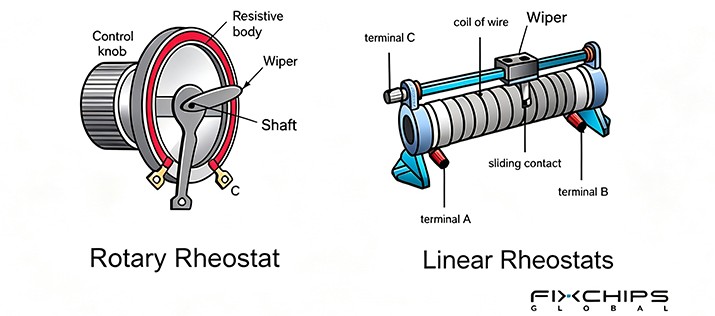
- Resistive element: This is the part that provides electrical resistance. Wire-wound rheostats use resistance wire wound around a supporting core.
- Wiper: The wiper is a movable electrical contact. It touches different positions on the resistive element.
- Terminals: Terminals connect the rheostat to the external circuit.
- Slider: A slider moves the wiper along a straight path in a linear design.
- Shaft: A shaft moves the wiper in a rotary rheostat.
- Knob: A knob allows the user to turn a rotary rheostat by hand.
Working Principle of Rheostats
A rheostat works by changing the resistance in the current path. When the wiper moves, it changes the length of the resistive element used by the circuit. A longer resistive path produces higher resistance, while a shorter path produces lower resistance.
The relationship between voltage, current, and resistance is described by Ohm's law:

where:
I = current in amperes (A)
V = voltage in volts (V)
R = resistance in ohms (Ω)
For a fixed voltage, increasing resistance reduces current. For example, in a 12 V circuit, a 6 Ω resistance gives:
I = 12 / 6 = 2 A
If the resistance is increased to 12 Ω:
I = 12 / 12 = 1 A
Therefore, the rheostat can reduce or increase current by changing the resistance.
The actual operating current must remain within the rheostat's rated limits. Its voltage, current, and power ratings should always be checked before use.
Key Characteristics of Rheostats
When selecting a rheostat, resistance and power rating are two important specifications. These values help determine whether a rheostat can work safely in a specific circuit.
Resistance
Resistance describes how strongly a component opposes current flow. It is measured in ohms (Ω).
A rheostat is usually specified by its maximum resistance. When used with two terminals, the resistance between the wiper and one end can be adjusted from a low value toward the rated resistance.
Unit
The standard unit of resistance is the ohm (Ω). Kilohms and megohms are used for larger resistance values.
|
Unit |
Symbol |
Conversion Relationship |
Example |
|
Milliohm |
mΩ |
1 Ω = 1,000 mΩ |
0.5 Ω = 500 mΩ |
|
Ohm |
Ω |
Basic unit |
10 Ω |
|
Kilohm |
kΩ |
1 kΩ = 1,000 Ω |
5 kΩ = 5,000 Ω |
|
Megohm |
MΩ |
1 MΩ = 1,000 kΩ |
1 MΩ = 1,000,000 Ω |
Power Rating
Power rating describes how much electrical power a rheostat can dissipate under its specified operating conditions. Because current flows through the resistive element, part of the electrical energy is converted into heat.
Power can be calculated using:
P = I²R /P = VI
For example, if 2 A flows through a 10 Ω rheostat:
P = 2² × 10 = 40 W
The rheostat must therefore be rated for the required power under the manufacturer's specified conditions.
Types of Rheostats
Rheostats can be grouped by their physical adjustment mechanism. The three common forms are linear rheostats, rotary rheostats, and preset rheostats.
Linear Rheostats
A linear rheostat changes resistance when the wiper moves along a straight path. The user adjusts the resistance by sliding the control from one position to another.
This design is useful when a direct sliding movement is preferred. The position of the slider can also make the direction of adjustment easy to see.

Advantages
- Simple and easy to operate
- Direct sliding adjustment
- Easy to observe the approximate adjustment position
Disadvantages
- Requires space for the sliding path
- Less compact than some rotary designs
Rotary Rheostats
A rotary rheostat changes resistance when the user turns a shaft. The shaft moves the wiper along the resistive element.
Rotary rheostats are useful for panel controls because a knob can provide a compact adjustment method. Many commercial rheostats use rotary construction.

Advantages
- Compact control method
- Easy to operate with a knob
- Suitable for panel mounting
- Available in many resistance and power combinations
Disadvantages
- The exact resistance position may not always be obvious
- The moving contact can wear over time
- High-power models can be large and heavy
Preset Rheostats
A preset rheostat is designed to be adjusted during setup rather than frequently during normal operation. It is normally adjusted with a tool or similar mechanism.
This type is useful when a circuit needs a resistance value to be set during installation, testing, or calibration and then left at that setting.

Advantages
- Simple adjustment mechanism.
- Useful for setup and calibration.
- Helps avoid accidental changes during normal operation.
Disadvantages
- Not convenient for frequent adjustment.
- May require access to the circuit or enclosure.
- Product resistance and power ratings vary widely.
Comparison of Different Rheostats
|
Comparison |
Linear Rheostat |
Rotary Rheostat |
Preset Rheostat |
|
Rated Power |
About 10–100 W |
About 7.5–150 W |
About 0.25–10 W |
|
Resistance Range |
About 10 Ω–10 kΩ |
About 0.5 Ω–50 kΩ |
About 10 Ω–1 MΩ |
|
Adjustment |
Straight-line movement |
Rotary movement |
Tool adjustment |
|
Key Feature |
Direct and easy-to-see slider control |
Compact knob control |
Set-and-leave adjustment |
|
Common Applications |
Laboratory equipment, manual controls |
Motor control, lighting, heating |
Circuit calibration, internal adjustment |
Note: The Rated power and resistance shown are common general ranges for reference. Actual values vary by device design, manufacturer, and application.
Rheostat Manufacturers
Several established electronic-component manufacturers produce rheostats or variable resistors that can operate in rheostat configurations.
Ohmite Manufacturing
Ohmite has produced high-power rheostats since 1925. Its products use wire-wound construction and an adjustable arm, with applications including motor and current control. Its current product range includes models from 7.5 W to 1,000 W, making it particularly notable for power-control applications.
Vishay Intertechnology
Vishay produces wire-wound rheostat/potentiometer products. Its current rheostat portfolio includes the RT12, RT25, and RT55 series, rated at 12 W, 25 W, and 55 W respectively. These products are designed for applications that require adjustable resistance.
Bourns
Bourns produces variable-resistor products, including potentiometers that can be used in rheostat configurations. When using a potentiometer as a rheostat, the wiper and one end terminal are used. The applicable wiper-current and power limits must be checked for the specific product.
Applications of Rheostats
Rheostats are mainly used where a circuit needs adjustable resistance or current control.
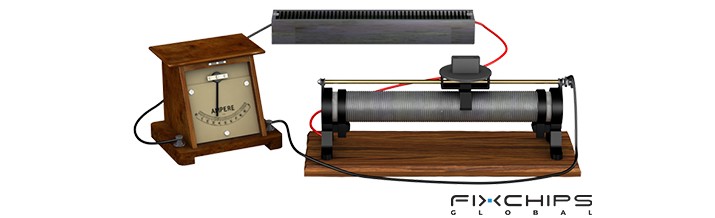
- Motor Control
A rheostat adds adjustable resistance to the motor circuit, changing the current flowing through the circuit. This can be used to adjust motor speed or starting conditions in suitable motor-control systems.
- Lighting Control
By changing the resistance, a rheostat can change the current supplied to a suitable light source. This allows the brightness to be adjusted in applications designed for resistive control.
- Heating Equipment
A rheostat controls the current flowing through a heating element by changing circuit resistance. Higher resistance reduces current and can reduce the heat produced by the load.
- Laboratory Equipment
Rheostats are used in laboratory circuits where resistance or current needs to be changed during testing. The user can move the wiper to study how different resistance values affect the circuit.
Rheostat vs Potentiometer
Rheostats and potentiometers are easy to confuse because both use a resistive element and a movable wiper. The main difference is how they are connected and what they are intended to control.
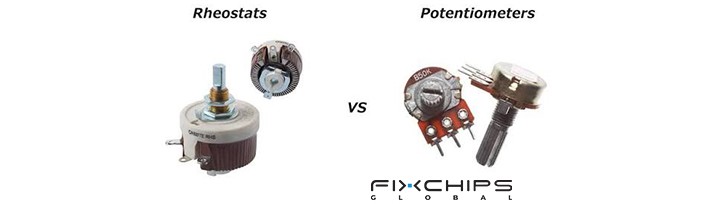
A potentiometer normally uses three terminals: the two ends of the resistive element and the wiper. It is commonly used as a voltage divider, where the wiper changes the ratio of resistance on either side.
A rheostat normally uses two terminals: the wiper and one end of the resistive element. This changes the resistance in the current path and is commonly used for current control.
The main differences are shown below:
|
Characteristic |
Rheostat |
Potentiometer |
|
Number of Terminals |
2 normally used |
3 normally used |
|
Purpose |
Adjust resistance and control current |
Divide or adjust voltage |
|
Typical Resistance Range |
0.5 Ω–50 kΩ |
1 kΩ, 5 kΩ, and 10 kΩ |
|
Typical Power |
Often higher-power; commercial examples range from 7.5 W to 1,000 W |
often lower-power, ratings vary by product |
|
Heat / Efficiency |
Can produce significant heat when carrying high current |
Usually lower power in signal/control applications |
|
Pros |
Good for adjustable current and power-control applications |
Good for voltage adjustment and signal control |
|
Cons |
Can generate heat and may require a high power rating |
Not normally intended for high-current control |
|
Common Applications |
Motor control, heating, lighting, laboratory equipment |
Audio controls, voltage dividers, signal adjustment |
Note: A potentiometer can also be used as a rheostat by connecting the wiper to one end terminal. However, the potentiometer must be rated for the required current and power.
Frequently Asked Questions
What sets a rheostat apart from a potentiometer?
A rheostat is normally used with two terminals to provide adjustable resistance and control current, while a potentiometer normally uses three terminals as a voltage divider. A potentiometer can also be wired with two terminals to work as a rheostat when its ratings are suitable.
Can rheostats be used to regulate AC current?
Yes, a rheostat can be used in an AC circuit when the component is specifically rated for the required AC voltage, current, and power. The rheostat changes the resistance in the circuit, which changes the current flowing through the load.
What are rotary rheostats commonly used for?
A rotary rheostat uses a rotating shaft to move its wiper and change the resistance in the circuit. It is commonly used for applications such as motor control, lighting control, heating equipment, and other systems that require adjustable current.
Can a rheostat be used as a light dimmer?
A rheostat can be used for dimming certain types of lights by changing the resistance and controlling the current through the load. However, a rheostat is not the same as a modern electronic dimmer, and the component must be properly rated for the specific lighting circuit.
How many terminals does a rheostat normally have?
A rheostat normally uses two terminals: the wiper and one end of the resistive element. Some rheostats are physically built with three terminals, but only two are normally used when the component operates as a rheostat.


