



Introduction
Memory acts as the high-speed workspace of any electronic device, allowing processors to instantly access critical data required for smooth operation. DDR5, LPDDR5, and LPDDR5X represent the pinnacle of modern RAM technology, driving performance boundaries across desktop computers, server farms, ultra-thin laptops, and mobile flagships.
This article breaks down their architectural designs, performance capabilities, and real-world applications to help you choose the right memory technology for your needs.
What is DDR5?
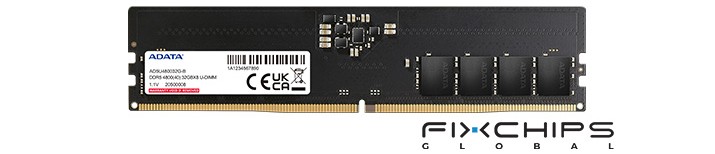
DDR5 (Double Data Rate 5) is the fifth generation of main system memory designed specifically for high-performance desktop PCs, workstations, and enterprise servers. Released by JEDEC to address severe memory bandwidth bottlenecks in multi-core processors, it delivers twice the data rate and significantly higher channel efficiency compared to DDR4.
Architecture of DDR5
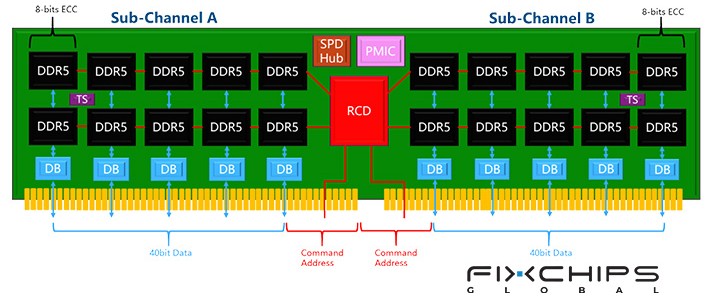
To understand how DDR5 achieves its speed, let us examine its core structural components:
- Dual Independent 32-bit Channels: Each physical DDR5 DIMM module is split into two independent 32-bit sub-channels (plus 8-bit ECC) to improve memory access efficiency and reduce command latency.
- On-DIMM Power Management IC (PMIC): DDR5 relocates power management directly onto the memory module itself rather than relying on the motherboard, enabling cleaner power delivery and enhanced voltage control.
- On-Die ECC (Error Correction Code): Built-in error correction logic inside the memory chip automatically detects and corrects single-bit errors in real time to stabilize high-density memory cells.
- Same-Bank Refresh (SBR): SBR allows the system to refresh one memory bank while other banks remain actively open for data read and write operations.
- Doubled Burst Length (BL16): DDR5 increases the default burst length from BL8 to BL16, allowing a single memory command to access 64 bytes of data—the standard CPU cache line size.
Key Features
- Operating core supply voltage is reduced from DDR4's 1.2V down to 1.1V for greater energy efficiency.
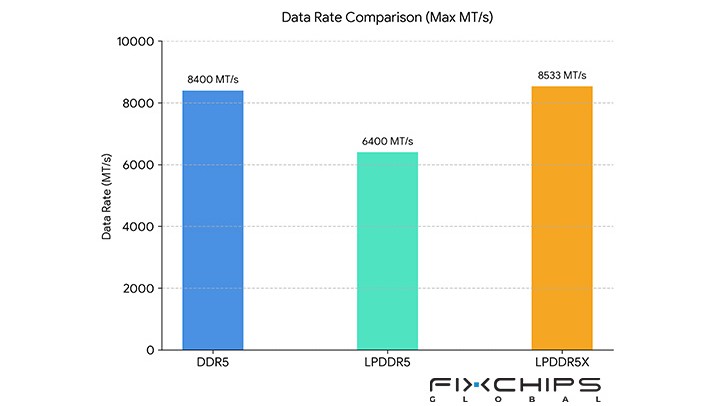
- Data transfer speeds start at 4800 MT/s and scale officially up to 8400+ MT/s.
- Supports double the memory density per die compared to DDR4, reaching up to 64Gb per single chip.
- Integrated thermal sensors monitor module temperatures in real time to prevent thermal throttling.
Applications
- High-performance desktop PCs and gaming rigs
- Enterprise cloud servers and data centers
- High-end workstation computers
What is LPDDR5?
LPDDR5 (Low Power Double Data Rate 5) is a specialized low-power memory standard designed specifically for battery-powered mobile devices, thin laptops, and automotive systems. Introduced by JEDEC to meet the rising computing demands of 5G smartphones and mobile AI, it balances extreme power savings with high data throughput.
Architecture of LPDDR5
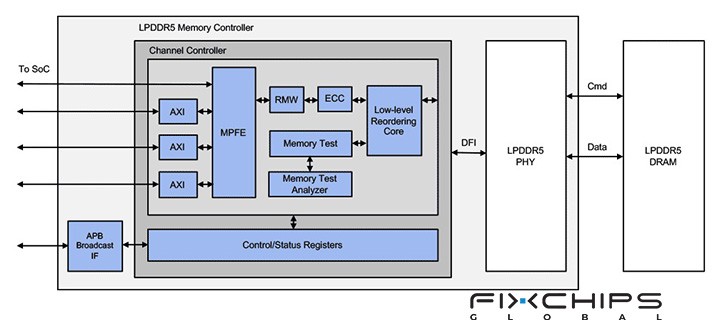
LPDDR5 shares fundamental memory cell concepts with DDR5, but incorporates specialized low-power architectural changes:
- Multi-Bank Architecture (16-Bank Structure): Replaces standard DDR structures with a flexible multi-bank architecture divided into bank groups, optimizing parallel data access for low-power operation.
- Dynamic Frequency and Voltage Scaling (DVFS): Allows the memory controller to dynamically adjust operating clock frequency and voltage based on current workload intensity.
- Signal Equalization Circuitry: Implements decision feedback equalization (DFE) on memory channels to ensure pristine signal integrity at high speeds without increasing power draw.
How LPDDR5 Reduces Power Consumption
LPDDR5 drastically reduces energy consumption through targeted circuit innovations.
First, it introduces Deep Sleep Mode, which cuts power usage by up to 40% during idle states compared to LPDDR4X.
Second, it uses Data-Copy and Write-X commands; Data-Copy transfers data directly from one pin to multiple pins without driving the internal array, while Write-X writes a string of zeros without transferring data, minimizing I/O toggle power.
Key Features
- Reaches data transfer rates up to 6400 MT/s.
- Operates on ultralow supply voltages (1.05V core / 0.5V I/O).
- Supports flexible Burst Length modes (BL16 / BL32) tuned for mobile chips.
Applications
- Flagship and mid-range 5G smartphones.
- Ultra-portable laptops, tablets, and lightweight ultrabooks.
- Automotive infotainment and Advanced Driver Assistance Systems (ADAS).
- Compact IoT edge computing gateways.
What is LPDDR5X?
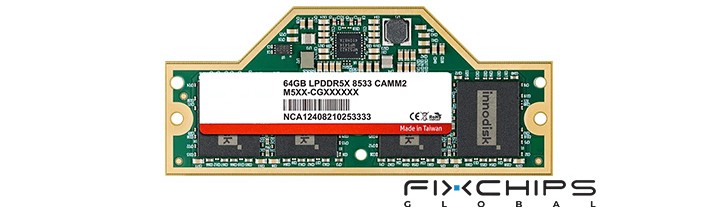
LPDDR5X is an upgraded version of LPDDR5 designed to meet the extreme speed demands of modern mobile devices. It was released to provide higher bandwidth and better power efficiency for AI processing on phones and laptops.
Key Upgrades
- Higher Speeds: Increases maximum data rates from 6400 MT/s up to 8533 MT/s.
- Enhanced Signal Integrity: Adds signal equalization technology to keep data stable at extreme frequencies.
- Better Energy Efficiency: Consumes up to 20% less power per bit transferred than LPDDR5.
- Enhanced Reliability: Adds robust adaptive refresh management to ensure signal integrity under heavy continuous loads.
Applications
- AI-enabled smartphones and mobile AI workstations.
- Premium ultra-thin laptops and handheld gaming consoles.
- Smart automotive cockpits and edge AI devices.
LPDDR5 vs LPDDR5X Comparison Table
|
Comparison Metric |
LPDDR5 |
LPDDR5X |
|
Maximum Data Rate |
Up to 6400 MT/s |
Up to 8533 MT/s |
|
Bandwidth (per module) |
Up to 51.2 GB/s |
Up to 68.2 GB/s |
|
Power Efficiency |
Standard high-efficiency mobile profile |
~20% improved energy efficiency per bit |
|
Latency |
Standard mobile latency baseline |
Slightly reduced due to higher operational frequencies |
|
AI Workload Support |
Basic mobile AI and machine learning tasks |
Optimized for complex on-device LLMs and generative AI |
|
Form Factor |
Soldered BGA / PoP (Package-on-Package) |
Soldered BGA / LPCAMM2 modular form factor |
|
Signal Architecture |
Standard mobile Differential Clocking |
Enhanced TX/RX Equalization with DFE |
|
Application |
Mainstream 5G smartphones & light laptops |
Flagship AI smartphones & high-performance ultrabooks |
Detailed Comparison of DDR5 and LPDDR5/5x
While sharing similar core naming conventions, standard DDR5 and mobile LPDDR5/5X represent vastly different engineering trade-offs tailored for distinct device environments.
Architectural & Structural Comparison
DDR5: Features dual 32-bit sub-channels per module with an on-board Power Management IC (PMIC) and modular DIMM channel structure.
LPDDR5: Employs a multi-bank architecture operating across 16-bit wide channels optimized for short trace lengths.
LPDDR5X: Retains the multi-bank 16-bit channel architecture of LPDDR5 but integrates enhanced signal equalization for high-frequency operations.
Packaging & Installation Comparison
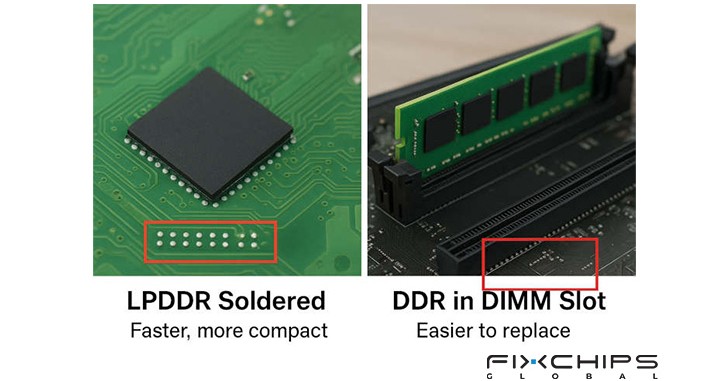
DDR5: Installed via standard removable socket connectors (UDIMM, SODIMM, RDIMM) allowing user installation and replacement.
LPDDR5: Permanently soldered onto the device motherboard (BGA) or stacked directly on top of the System-on-Chip (PoP).
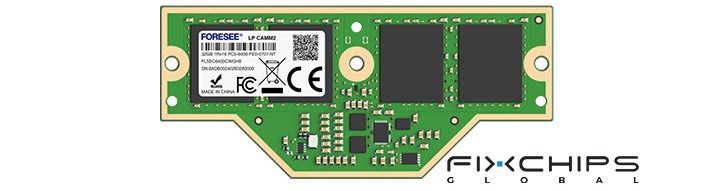
LPDDR5X: Primarily soldered via BGA/PoP, with emerging support for removable LPCAMM2 low-power modular sockets.
Performance Comparison
DDR5: Focuses on sustained heavy throughput and massive parallel operations, with speeds ranging from 4800 to 8400+ MT/s across wider 64-bit buses.
LPDDR5: Delivers swift burst speed up to 6400 MT/s, tuned specifically for quick responsive bursts before returning to idle.
LPDDR5X: Outpaces standard baseline DDR5 in raw data rate (up to 8533 MT/s), maximizing peak memory bandwidth for mobile SOCs.
Power & Energy Efficiency Comparison
DDR5: Operates at a base voltage of 1.1V with active power draw reaching 2W to 5W per DIMM module, prioritizing max clock speeds over energy savings.
LPDDR5: Uses dynamic scaling down to 0.5V with Deep Sleep modes, keeping power draw under 1W for extended battery life.
LPDDR5X: Further refines energy utilization, consuming up to 20% less power per gigabyte transferred than LPDDR5.
Capacity & Upgradability Comparison
DDR5: Offers massive memory capacity potential (up to 128GB+ per single slot in desktop/servers) and full user upgradability.
LPDDR5: Limited to lower capacities (typically 8GB to 32GB) fixed permanently at manufacture time with zero upgradability.
LPDDR5X: Scales up to 64GB in high-end devices, remaining non-upgradable in soldered setups unless utilizing LPCAMM2 modules.
Application Suitability Comparison
DDR5: Ideal for wall-powered systems where thermal headroom is sufficient and expandable RAM capacity is required.
LPDDR5: Tailored for mobile devices where battery endurance, thermal control, and physical compact size are absolute priorities.
LPDDR5X: Essential for premium battery-operated computing platforms executing heavy localized AI tasks and high-end graphics processing.
DDR5 VS LPDDR5/5X Comparison Table
|
Comparison Category |
DDR5 |
LPDDR5 |
LPDDR5X |
|
Architecture & Structure |
Dual 32-bit channels On-Die ECC 32 Banks |
WCK clocking 16 Banks / Bank Groups |
Enhanced WCK clocking Signal Equalization |
|
Packaging & Installation |
Removable DIMM / SO-DIMM slots |
Soldered BGA / Package-on-Package (PoP) |
Soldered BGA / PoP / LPCAMM2 |
|
Performance (Data Rate) |
4800 – 8400+ MT/s |
Up to 6400 MT/s |
Up to 8533+ MT/s |
|
Power & Efficiency |
1.1V steady draw |
1.05V / 0.5V dynamic scaling, Deep Sleep |
1.05V / 0.5V dynamic scaling +20% efficiency vs LP5 |
|
Capacity & Upgradability |
Up to 128GB+/slot User Upgradable |
Fixed (8GB–32GB) Non-upgradable |
Fixed (12GB–64GB) Non-upgradable |
|
Application Suitability |
Desktops, Workstations, Servers |
Smartphones, Thin Laptops, Automotive |
AI Mobile, Flagship Phones, AI PCs |
DDR5 vs LPDDR5/5X: How to Choose?
Selecting the optimal memory technology depends on your target form factor, power availability, and performance demands.
Advantages & Disadvantages Overview
|
Memory Type |
Pros |
Cons |
|
DDR5 |
• User-upgradable • High maximum RAM capacity • Excellent for heavy multi-tasking and continuous workloads |
• Higher power consumption • Requires larger physical slot space • Generates more heat |
|
LPDDR5 |
• Highly energy-efficient with long battery standby • Compact physical footprint • Lower cost for standard mobile devices • Cannot be upgraded after purchase |
• Cannot be upgraded after purchase • Lower top speed than LPDDR5X • Limited by thermal throttle under continuous heavy load |
|
LPDDR5X |
• Fastest bandwidth for mobile chips • Highest power efficiency per bit • Optimized for mobile AI and graphics |
• Cannot be upgraded after purchase • Higher manufacturing cost • Tied to compact/soldered designs |
Selecting Products by Application Scenario
- Desktop Gaming & Professional Workstations: Choose DDR5. The ability to install 32GB, 64GB, or more RAM while allowing future memory capacity upgrades makes DDR5 the undisputed choice for heavy workloads and gaming.
- Enterprise Cloud & Local Data Servers: Choose DDR5 (ECC RDIMMs). Enterprise operations rely on massive memory capacity, replacement serviceability, and system-wide fault tolerance.
- Mainstream Smartphones & Light Ultrabooks: Choose LPDDR5. Provides the ideal balance between swift operational speed and long battery life for web browsing, media streaming, and general productivity.
- Premium Flagship Smartphones & AI PCs: Choose LPDDR5X. Local execution of generative AI models, complex image generation, and high-frame-rate mobile gaming require the ultra-high 8533 MT/s bandwidth that LPDDR5X delivers while maintaining tight thermal limits.
Frequently Asked Questions
Can I replace LPDDR5 with LPDDR5X in a laptop?
Usually, no. LPDDR5 memory is commonly soldered directly to the laptop motherboard, so it cannot be removed and replaced like a standard DDR5 SO-DIMM. Some newer modular designs, such as LPCAMM2, support replaceable LPDDR5X memory, but compatibility depends on the laptop's motherboard and memory controller.
What is the main difference between DDR5 and LPDDR5?
The main difference is their design focus: DDR5 is designed for high-performance and expandable systems, while LPDDR5 prioritizes low power consumption and compact device designs. DDR5 is commonly used in desktops, workstations, and servers, whereas LPDDR5 is widely used in smartphones, tablets, and thin laptops.
What makes DDR5 use more power than LPDDR5?
DDR5 is designed to provide high sustained performance and is typically used in systems with greater power and thermal headroom. LPDDR5 uses low-power features such as dynamic voltage and frequency scaling and low-power operating modes, making it better suited to battery-powered devices.
Does LPDDR5X offer advantages for gaming performance?
LPDDR5X can be beneficial for gaming devices because it offers higher memory data rates and bandwidth while maintaining a low-power design. However, gaming performance also depends heavily on the CPU, GPU, cooling system, and software, so LPDDR5X alone does not guarantee better gaming performance.
Is DDR5 faster than LPDDR5X?
Not necessarily. LPDDR5X supports data rates up to 8533 MT/s in the referenced specifications, while DDR5 has a wide range of supported speeds depending on the memory module and platform. Therefore, LPDDR5X can have a higher raw data rate than some DDR5 configurations, although data rate alone does not determine overall system performance.


