




A fuel pump relay is an electrical switch that controls power to the fuel pump. It allows a low-power control signal to switch a higher-current fuel pump circuit, making it an important part of many vehicle fuel systems.
What Is a Fuel Pump Relay?
A fuel pump relay is a relay used to turn the fuel pump circuit on and off. Its design separates the control circuit from the higher-current pump circuit. This helps the vehicle control the pump without sending pump current through a small control switch or control output.
A common electromechanical relay is simple and widely used. However, its mechanical contacts can wear over time.
Solid-state designs remove mechanical contacts but use electronic switching components and have different heat-management requirements.
Fuel pump relays are used in vehicle fuel systems, although the exact design can differ by vehicle.
Functions of Fuel Pump Relay
- Switches power to the fuel pump
- Separates the control circuit from the pump power circuit
- Allows a small control signal to operate a higher-current circuit
- Turns the fuel pump on and off as required by the vehicle control system
How Does a Fuel Pump Relay Work?
The fuel pump relay works between the vehicle control system, power supply, and fuel pump. In a common system, the control side activates the relay, while the relay contacts connect battery power to the fuel pump.
Fuel Pump Relay Wiring Diagram
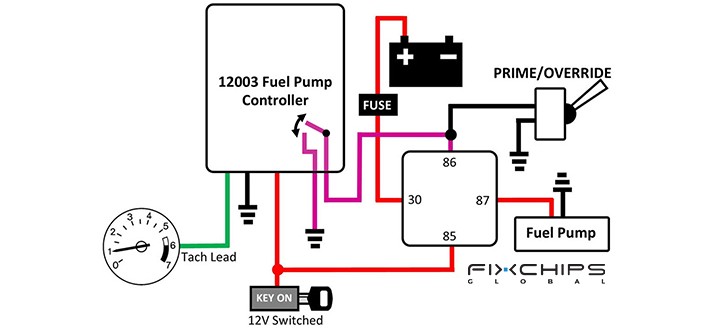
A standard 4-pin relay commonly uses two terminals for the coil and two for the switched power path. In a typical fuel pump circuit, the relay receives a control signal and then connects battery power to the fuel pump. Exact wiring can vary by vehicle.
|
Pin |
Connected Device |
Function |
|
85 |
Ground / control ground |
Completes the relay coil circuit |
|
86 |
Ignition or ECU control circuit |
Activates the relay coil |
|
30 |
Battery power through a fuse |
Supplies power to the relay contact |
|
87 |
Fuel pump |
Sends switched power to the pump |
Note: This is a common 4-pin relay arrangement, not a universal fuel-pump wiring rule. Some vehicles use different relay layouts or integrate the relay into another control module.
Working Principle
When the vehicle control system activates the relay, current flows through the relay coil. The coil creates a magnetic field that moves the internal contact and connects terminal 30 to terminal 87 in a normally open relay.
Battery power can then reach the fuel pump. In many engine-management systems, the control unit can switch the fuel pump on during starting or engine operation and turn it off when the engine is not running.
Specifications of Fuel Pump Relay
Fuel pump relay specifications depend on the vehicle and relay design. The table below uses common values found in automotive relay products rather than treating them as universal specifications.
|
Parameter |
Common Data |
|
Rated Voltage |
12 V DC |
|
Contact Rating |
About 30–40 A for common automotive relays |
|
Number of Pins |
4 pins for a common SPST-NO design |
|
Contact Type |
Normally Open (NO) |
|
Coil Resistance |
About 85–90 Ω in some common 12 V relay designs |
How to Find the Fuel Pump Relay?
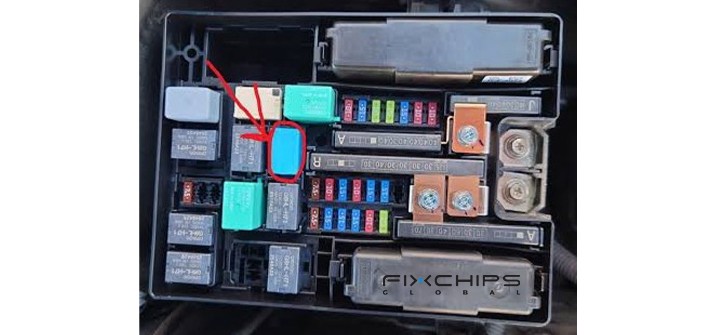
The fuel pump relay is commonly found in a vehicle's fuse and relay box. Depending on the vehicle, this box may be in the engine compartment or another protected area.
The relay can often be identified from the fuse-box cover, vehicle manual, or wiring diagram. Nearby components may include fuses and other relays, but their exact arrangement depends on the vehicle. Service information for different vehicles shows fuel pump relays in different locations and circuit layouts.
Types of Fuel Pump Relay
Fuel pump relays can be divided into different types based on how they switch electrical power. The main types include electromechanical relays, solid-state relays, and integrated fuel pump relay modules.
Electromechanical Fuel Pump Relay
An electromechanical fuel pump relay uses a coil and mechanical contacts to switch power. When the coil is energized, it moves the contacts and connects power to the fuel pump.
This type has a simple design and is widely used in vehicle electrical systems. However, the mechanical contacts can wear over time because they move and switch current repeatedly.

Solid State Fuel Pump Relay
A solid-state fuel pump relay uses electronic components instead of moving mechanical contacts. It switches the fuel pump circuit electronically when it receives the required control signal.
It has no mechanical contacts to wear out and can provide fast switching. However, it needs suitable electrical and heat control because the electronic switching parts can produce heat during operation.

Integrated Fuel Pump Relay Module
An integrated fuel pump relay module combines the relay function with other electronic control functions in one module. It can control the fuel pump as part of a larger vehicle control system.
This design can reduce separate wiring and components. However, the structure is more complex than a simple plug-in relay, and its design depends on the vehicle system.

Main Manufacturers of Fuel Pump Relay
Several established automotive electrical-component manufacturers produce relays used in fuel pump and other vehicle circuits.
Bosch
Bosch offers automotive relays in different sizes and current ranges. Its aftermarket information specifically lists mini relays for fuel pump applications and provides vehicle relay replacement information.
DENSO
DENSO has more than 60 years of experience producing automotive relays. Its relay range includes 12 V plug-in relays with different contact and current ratings for vehicle applications.
HELLA
HELLA produces a broad range of automotive relays, including 12 V 4-pin normally open relays. Its published specifications include different current ratings, coil resistances, and switching-cycle ratings.
Symptoms of a Bad Fuel Pump Relay
A failed fuel pump relay can interrupt power to the fuel pump. As a result, the engine may have difficulty starting or may stop running if fuel delivery is lost. Here are some Symptoms

- Engine does not start — If the relay fails to close the pump circuit, the fuel pump may not receive power, so the engine may not receive the fuel supply needed for starting.
- Engine stalls — If relay contacts open during operation, power to the fuel pump can be interrupted and the engine may stop.
- Intermittent starting problems — Worn or damaged relay contacts can make the pump circuit work inconsistently, causing starting problems that may come and go.
- Fuel pump does not operate when commanded — A failed coil, damaged contacts, or an electrical problem in the relay circuit can prevent the relay from switching the pump circuit.
- Relay shows electrical or physical damage — Heat, arcing, or contact wear can damage relay contacts and affect switching performance.
Important: These symptoms can also come from a failed fuel pump, fuse, wiring, connector, or control circuit. A symptom alone does not prove that the relay is faulty.
How to Test a Fuel Pump Relay?
Before testing, remove the relay from the vehicle and identify its terminals. Because relay layouts and suppression components can differ, check the relay diagram or vehicle service information first.
|
Step |
Description |
Tip |
|
1 |
Turn off the vehicle and remove the relay. |
Prevent accidental short circuits. |
|
2 |
Set the multimeter to resistance mode. |
Use the Ω setting. |
|
3 |
Measure across the coil terminals, usually 85 and 86. |
Compare the reading with the relay specification. |
|
4 |
Check for an open coil. |
Infinite resistance indicates an open coil. |
|
5 |
Check the normally open contact with the relay unpowered. |
A normally open contact should not show continuity. |
|
6 |
If the relay design allows it, energize the coil with its specified voltage. |
Use the rated voltage and correct polarity when required. |
|
7 |
Check the switched contact again. |
The normally open contact should close when the relay operates. |
Applications of Fuel Pump Relay
Fuel pump relays are used to control fuel-pump power in vehicle fuel systems. Automotive relay manufacturers also list fuel pumps among common relay applications.
General Applications
- Passenger cars
- Light commercial vehicles
- Trucks
- Buses
- Internal-combustion engine fuel systems
Specific Applications
- Electric fuel pump control
- In-tank fuel pump systems
- Engine starting fuel supply
- Engine running fuel supply
- Fuel pump power switching
Fuel Pump Relay vs Starter Relay
A starter relay is used to control the electrical circuit that activates the starter system. Both starter relays and fuel pump relays use a control circuit to switch a higher-current circuit.
But they serve different loads and functions. Automotive relay products are available for both fuel pump and starter-related applications.
|
Feature |
Fuel Pump Relay |
Starter Relay |
|
Function |
Controls power to the fuel pump |
Controls power to the starter circuit |
|
Role in System |
Supplies power to the electric fuel pump |
Sends power to the starter control circuit |
|
Location |
Fuse and relay box |
Fuse and relay box or starter circuit |
|
Control Circuit Current |
Low current, typically below 0.2 A |
Low current, typically below 0.2 A |
|
Typical Relay Voltage |
12 V DC |
12 V DC |
|
Typical Contact Rating |
About 30 A |
About 50 A |
|
Response to Engine Failure |
Stops fuel pump operation when the control system removes the relay signal |
Prevents the starter circuit from operating when the start command is not given |
|
Cost |
Usually a low-cost automotive relay |
Usually a low-cost automotive relay |
|
Lifespan |
About 100,000 electrical operations |
About 100,000 electrical operations |
|
Typical Uses |
Electric fuel pumps and fuel delivery systems |
Starter motor control and engine starting systems |
Frequently Asked Questions
What does a fuel pump relay do?
A fuel pump relay is an electrical switch that controls power to the fuel pump. In many vehicle systems, it helps turn the pump on when needed and cut its power when the engine stops.
How can you tell if a fuel pump relay is going bad?
A bad relay can stop power from reaching the fuel pump, which may cause starting problems or loss of fuel pump operation. However, similar symptoms can also come from other parts of the fuel system, so testing is needed to confirm the relay.
Is it possible to run a vehicle without its fuel pump relay?
In a system that uses a separate fuel pump relay, the relay is needed to switch power to the pump. If the relay fails or is removed, the fuel pump may not operate, so the engine may not start or may stop running.
Can weather affect a fuel pump relay?
Yes. Relay operation can be affected by temperature because temperature changes the coil resistance and operating characteristics. Automotive relays are therefore designed for specified temperature ranges, but the actual range depends on the relay design.
What is the typical service life of a fuel pump relay?
There is no single fixed service life for every fuel pump relay. As a general relay reference, electrical life is often rated at 100,000 operations or more, while mechanical life can be much higher; actual contact life depends on the load and switching conditions.


