



Introduction
A variable capacitor is a capacitor whose capacitance can be adjusted within a specified range. It is widely used when a circuit needs to change its capacitance to control functions such as frequency tuning, signal matching, or calibration.
This article explains what variable capacitors are, how they work, their main types, key manufacturers, and common applications.
What Is a Variable Capacitor?
A variable capacitor is a capacitor whose capacitance can be changed by adjusting its physical structure or applying a control voltage. It normally consists of two conductive electrodes separated by an insulating material, called a dielectric, or a semiconductor junction in the case of a varactor diode.
Functions of Variable Capacitors
Variable capacitors are mainly used in circuits where capacitance needs to be adjusted during operation or circuit tuning.
- RF tuning circuits: A variable capacitor changes the capacitance in a resonant circuit, allowing the circuit to adjust its operating frequency.
- Oscillator circuits: It can adjust the resonant frequency of an LC circuit. In a voltage-controlled oscillator, a varactor diode provides voltage-controlled capacitance.
- Impedance matching circuits: The capacitance can be adjusted to help match circuit impedance, which is important in RF and microwave systems.
- Calibration circuits: A small variable capacitor, such as a trimmer, can be adjusted during circuit setup to compensate for component and circuit tolerances.
Capacitance of Variable Capacitors
For an ideal parallel-plate capacitor, capacitance can be calculated using:
Where:
C = capacitance
ε = permittivity of the dielectric material
A = effective overlapping area of the electrodes
d = distance between the electrodes
A variable capacitor uses this relationship by changing the electrode overlap area (A) or the distance between the electrodes (d). Some electronic variable capacitors use voltage-controlled effects in semiconductor junctions to effectively change their capacitance.
How Are Variable Capacitors Represented?
Variable capacitors can be identified in circuit diagrams and component specifications in several common ways:
- Circuit symbol: A variable capacitor is generally shown as a capacitor symbol with a diagonal arrow through or across it. The arrow indicates that the capacitance can be adjusted.

- Unit: Capacitance is measured in farads (F). For variable capacitors, smaller units such as picofarads (pF) and nanofarads (nF) are commonly used, depending on the component.
- Reference designator: In circuit diagrams, variable capacitors are commonly identified with the letter C, together with a number such as C1 or C2. The exact reference-designator convention can depend on the schematic or design standard being used.
Working Principle of Variable capacitors
Variable capacitors can be divided into two main groups according to how their capacitance is adjusted: mechanical variable capacitors and electronic variable capacitors.
Mechanical Variable Capacitors
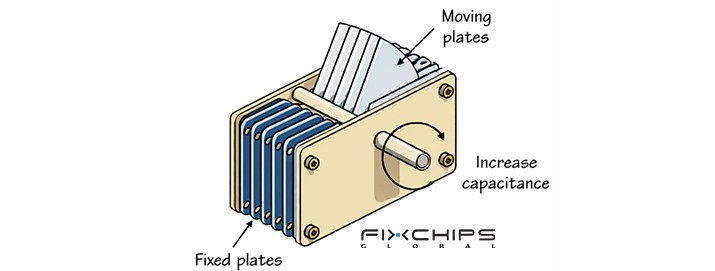
Mechanical variable capacitors change capacitance by physically changing the relationship between their electrodes. In rotary designs, turning a shaft changes the overlapping area between fixed and moving plates.
When the effective overlapping area is larger, the capacitance is higher. When the overlapping area is smaller, the capacitance is lower.
In other mechanical adjustable structures, capacitance can also be changed by adjusting the electrode spacing or another part of the capacitor structure. The exact movement depends on the capacitor design.
Electronic Variable Capacitors
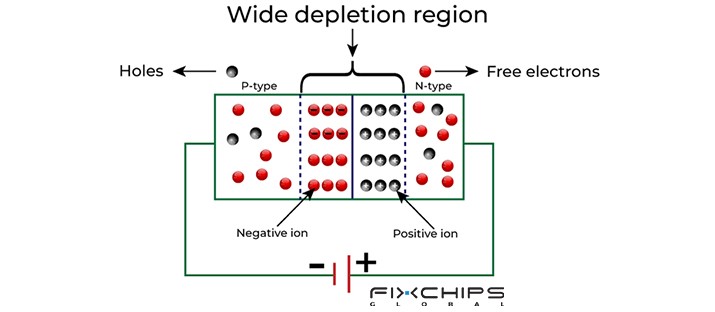
Electronic variable capacitors change capacitance through an electrical control signal rather than mechanical movement. A common example is the varactor diode, which uses the capacitance of a PN junction under reverse bias.
As reverse-bias voltage increases, the depletion region becomes wider. This reduces the junction capacitance. Therefore, within its specified operating range, a varactor generally has higher capacitance at lower reverse bias and lower capacitance at higher reverse bias.
Types of Variable Capacitors
Variable capacitors come in different designs. Their structures and adjustment methods determine where they are most useful.
Mechanical Variable Capacitors
Mechanical variable capacitors use physical movement to adjust capacitance. The main types differ mainly in their dielectric material, operating environment, and adjustment method.
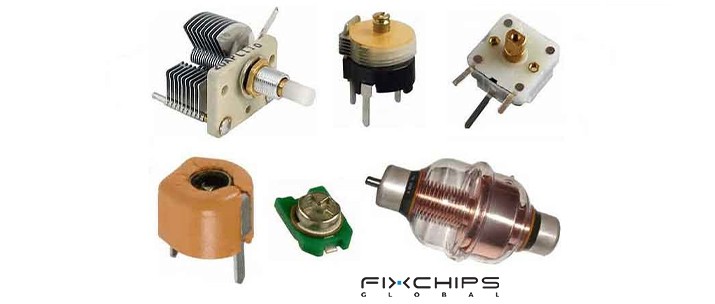
Air-Dielectric Rotary Capacitor
An air-dielectric rotary capacitor uses air as the dielectric between its conductive plates. A rotating set of plates changes the amount of overlap between the fixed and moving plates.
Its simple structure allows smooth mechanical tuning. These capacitors have traditionally been used in applications such as radio-frequency tuning, where direct adjustment of capacitance is useful.

Film-Dielectric Rotary Capacitor
A film-dielectric rotary capacitor uses a plastic film or other insulating film as its dielectric. Its capacitance is adjusted mechanically, usually by changing the effective electrode overlap.
Compared with an air-dielectric structure, the film provides a solid insulating layer. Film variable capacitors are used where a compact mechanically adjustable capacitor is required.

Vacuum Variable Capacitor
A vacuum variable capacitor places its electrodes inside a sealed vacuum enclosure. The vacuum provides the insulating medium between the electrodes.
These capacitors are designed for applications that require variable capacitance together with high voltage or RF performance. They are used in areas such as high-power RF systems and industrial equipment.

Trimmer Capacitor
A trimmer capacitor is a small mechanical adjustable capacitor designed for fine capacitance adjustment. It usually uses a movable screw or similar mechanism to change the electrode position and capacitance. Trimmer capacitors are mainly used for circuit tuning and calibration during manufacturing or testing.

Electronic Variable Capacitors
Electronic variable capacitors change capacitance through electrical control. Unlike mechanical types, they do not need a moving electrode.
Varactor Diodes
A varactor diode, also called a variable-capacitance diode, is a semiconductor device designed to provide voltage-dependent capacitance.
It is normally operated under reverse bias. Increasing the reverse voltage widens the depletion region and reduces the junction capacitance. This makes varactors useful for electronic frequency tuning in RF circuits, oscillators, and PLL-based systems.

Variable Capacitor Comparison
The main differences between variable capacitor types are their adjustment method, key structural feature, and typical application.
|
Type |
Capacitance Range |
Adjustment Method |
Key Feature |
Typical Use |
|
Air-Dielectric Rotary Capacitor |
10–500 pF |
Mechanical rotation |
Air dielectric and variable plate overlap |
RF and radio tuning |
|
Film-Dielectric Rotary Capacitor |
10–500 pF |
Mechanical rotation |
Film dielectric |
Adjustable RF and electronic circuits |
|
Vacuum Variable Capacitor |
10 pF–10,000 pF |
Mechanical adjustment |
Vacuum insulation and high-voltage capability |
High-power RF systems |
|
Trimmer Capacitor |
1–100 pF |
Screw or mechanical adjustment |
Compact fine adjustment |
Calibration and circuit tuning |
|
Varactor Diode |
1–500 pF |
Reverse-bias voltage |
Voltage-controlled capacitance |
RF tuning, VCOs, PLLs |
Note: The capacitance ranges shown are common general ranges for reference. Actual values vary by device design, manufacturer, and application.
Major Variable Capacitor Manufacturers
Several established electronic-component manufacturers offer variable capacitors or related tuning components. Their product ranges differ by technology and application.
Vishay Intertechnology
Vishay is a major global manufacturer of electronic components and offers variable and trimmer capacitors. Its products cover different dielectric technologies and capacitance ranges, making them suitable for circuit tuning and adjustment.
KYOCERA AVX
KYOCERA AVX is a major capacitor manufacturer with products covering RF and microwave applications. Its capacitor portfolio emphasizes high-frequency performance and reliability, making its products suitable for telecommunications, automotive, industrial, and other electronic systems.
Johanson Manufacturing
Johanson is an established manufacturer of RF and microwave components, including trimmer capacitors. Its products are mainly focused on RF tuning and impedance matching, giving them a more specialized position than manufacturers with broader general-purpose capacitor portfolios.
Applications of Variable Capacitors
Variable capacitors are useful whenever a circuit needs adjustable capacitance. Their applications range from simple tuning to high-frequency electronic control.
- Radio and RF tuning: Mechanical variable capacitors can adjust the resonant frequency of an RF circuit. Changing capacitance changes the circuit's resonant behavior.
- Voltage-controlled oscillators: Varactor diodes can change capacitance according to a control voltage. This allows a VCO to change its output frequency electronically.
- Phase-locked loops: Varactors are commonly used as tuning elements in VCOs that form part of PLL systems. The control voltage changes the varactor capacitance and, in turn, the oscillator frequency.
- RF impedance matching: Adjustable capacitance can help match the impedance between RF circuit stages or between a circuit and its load.
- Filter adjustment: Variable capacitance can change the response of an LC filter. This allows the circuit to be tuned to a required frequency.
- Circuit calibration: Trimmer capacitors are useful for fine adjustment during production or testing. They can compensate for small capacitance differences caused by component tolerances and the circuit itself.
- Frequency compensation: Varactors can also be used to adjust the frequency of oscillator and clock circuits. For example, changing varactor capacitance can fine-tune the resonant frequency of a crystal-based oscillator.
Frequently Asked Questions
What is a variable capacitor?
A variable capacitor is a capacitor whose capacitance can be intentionally adjusted within a specified range. Mechanical types change capacitance by moving the plates, while electronic types such as varactor diodes use voltage to control capacitance.
Where are variable capacitors commonly used?
Variable capacitors are commonly used in circuits that require adjustable frequency or tuning. Typical applications include RF tuning, oscillators, filters, impedance matching, and circuit calibration.
How does a variable capacitor differ from a fixed capacitor?
A fixed capacitor has a capacitance value that is designed to remain essentially constant, while a variable capacitor allows its capacitance to be adjusted within a specified range. Variable capacitors are therefore useful when a circuit needs capacitance to be tuned after or during assembly.
Can a varactor diode replace a mechanical variable capacitor?
A varactor diode can replace a mechanical variable capacitor in some tuning circuits, but it is not a direct replacement in every application. A varactor requires a suitable reverse-bias control circuit, and its capacitance range, voltage characteristics, and RF performance must match the original circuit requirements.
What is the symbol of a variable capacitor?
A variable capacitor is generally represented by the standard capacitor symbol with an additional diagonal arrow indicating that its capacitance can be adjusted. The exact graphical style can vary between schematic standards, but the adjustment indicator distinguishes it from a fixed capacitor.


