




Introduction
An AC fan motor is an electric motor that uses alternating current (AC) to drive fan blades and move air. This article explains its structure, working principle, main types, common problems, testing methods, and replacement steps.
What Is an AC Fan Motor?
An AC fan motor converts electrical energy into mechanical energy. It uses alternating current to create a magnetic field that makes the rotor turn. The rotor drives the fan blades to produce airflow.
AC fan motors are used in many devices and systems. Common examples include ceiling fans, air conditioners, ventilation systems, refrigerators, and industrial cooling equipment. Their main job is to move air, remove heat, and improve air circulation.
How Does an AC Fan Motor Work?
An AC fan motor has two main parts: an electrical section and a mechanical section. These parts work together to turn electrical power into mechanical motion.
Structure
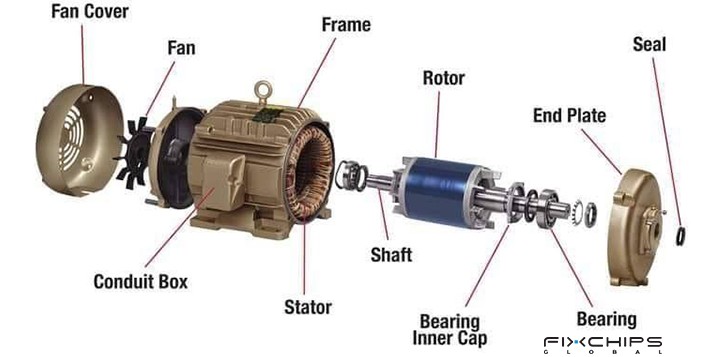
The structure of an AC fan motor can be divided into electrical and mechanical parts.
Electrical Parts
- Stator Windings: Copper coils that create a magnetic field when AC flows through them.
- Terminal Block: Connects the motor to the external power supply.
- Thermal Protector: Cuts off power when the motor becomes too hot.
Mechanical Parts
- Rotor: The rotating part that turns when it interacts with the stator's magnetic field.
- Shaft: Transfers the rotor's rotation to the fan blades.
- Bearings: Support the shaft and help it rotate with less friction.
- Motor Housing: Holds and protects the internal motor parts.
- Fan Blades or Impeller: Move air when the motor shaft rotates.
Working Principle
An AC fan motor uses the interaction between magnetic fields to turn electrical energy into rotational motion.
The basic working steps are:
|
Step |
Working Process |
Description |
|
1 |
Power Supply |
AC power enters the motor through its terminals. |
|
2 |
Magnetic Field Creation |
Current flows through the stator windings and creates a magnetic field. |
|
3 |
Starting Torque |
The motor creates the phase difference or rotating field needed to start the rotor. |
|
4 |
Rotor Rotation |
The magnetic field interacts with the rotor and produces rotational force. |
|
5 |
Power Transfer |
The rotor turns the shaft, which drives the fan blades. |
|
6 |
Air Movement |
The rotating blades push air and create airflow. |
Types of AC Fan Motors
Different AC fan motors use different winding designs and starting methods. These differences affect their starting torque, efficiency, speed control, and applications.
Shaded-Pole Motor
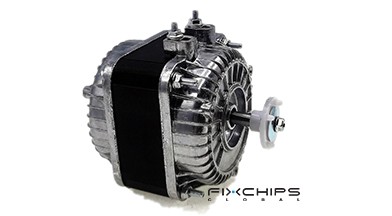
A shaded-pole motor is a simple single-phase induction motor. It usually has a laminated steel stator, copper windings, a squirrel-cage rotor, and a copper shading ring around part of each pole.
The shading ring creates a weak rotating magnetic field that starts the rotor. It has low starting torque and low efficiency, so it is mainly used in small fans, blowers, and household appliances.
Permanent Split Capacitor (PSC) Motor
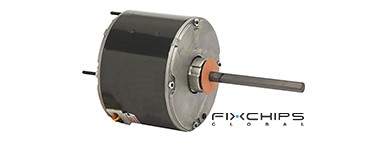
A PSC motor has a main winding, an auxiliary winding, a squirrel-cage rotor, and a run capacitor. The capacitor stays connected to the auxiliary winding during both starting and normal operation.
It offers relatively quiet operation, moderate efficiency, and low to moderate starting torque. It is widely used in HVAC blowers, air conditioners, and ventilation fans.
Capacitor-Start / Capacitor-Run (CSCR) Motor
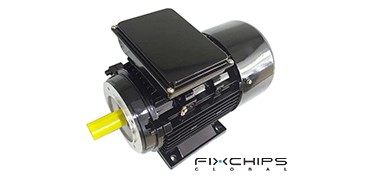
A CSCR motor has a main winding, an auxiliary winding, a starting capacitor, and a running capacitor. The starting capacitor provides extra torque during startup, while the running capacitor stays connected during normal operation.
A switch or relay disconnects the starting capacitor after the motor accelerates. This design provides high starting torque and good running performance, making it suitable for larger fans, compressors, and pumps.
Split-Phase Motor
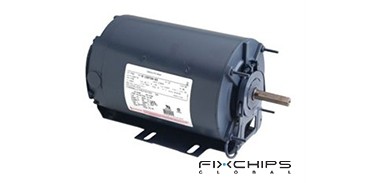
A split-phase motor has a main winding, a starting winding, a squirrel-cage rotor, and a centrifugal switch or other starting switch. The two windings have different electrical characteristics, which create a phase difference during startup.
The switch disconnects the starting winding when the motor reaches its operating speed. It has relatively low starting torque and is used in small fans, blowers, and other light-starting equipment.
Three-Phase AC Induction Motor
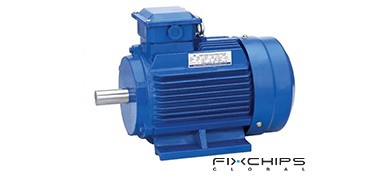
A three-phase AC induction motor has a stator with three sets of windings and usually a squirrel-cage rotor made of conductive bars and end rings. The three-phase power supply creates a rotating magnetic field that drives the rotor.
It provides smooth operation, reliable performance, and good efficiency. It is commonly used in industrial fans, ventilation systems, cooling towers, and large air-handling equipment.
Electronically Commutated Motors (ECM / EC Fans)
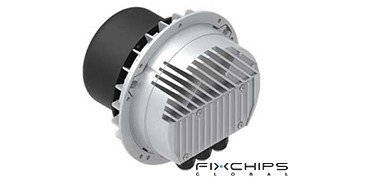
An ECM uses a permanent-magnet rotor, stator windings, and an electronic control module. The control module manages the current supplied to the windings and controls the rotor's rotation.
EC motors offer high efficiency and flexible speed control. They are commonly used in HVAC systems, refrigeration equipment, and energy-saving ventilation fans. Some EC fans accept AC input and convert it internally for electronic motor control.
AC Fan Motor Comparison
|
Type |
Horsepower (HP) |
Voltage |
Starting Torque |
Relative Efficiency |
Speed Control |
Uses |
|
Shaded-Pole |
Fractional HP, below 1/2 HP |
single-phase AC |
Very Low |
20–40% |
Limited |
Small fans, blowers |
|
PSC |
Fractional HP, up to 1/3 HP |
single-phase AC |
Low to Moderate |
60–70% |
Multi-speed or electronic control |
HVAC fans, air conditioners |
|
CSCR |
Fractional to several HP, up to about 10 HP |
single-phase AC |
High |
70–80% |
Limited or external control |
Large fans, compressors |
|
Split-Phase |
Fractional HP, up to 1/2 HP |
single-phase AC |
Low to Moderate |
50–60% |
Limited |
Small fans, blowers |
|
Three-Phase Induction |
Fractional HP to many HP |
three-phase AC |
Moderate to High |
85–95% |
VFD |
Industrial fans, cooling towers |
|
ECM / EC |
Fractional HP to higher-power designs |
AC input or DC |
Variable / High |
80–95% |
Electronic variable speed |
HVAC, refrigeration, ventilation |
Signs of Bad AC Fan Motors
A faulty AC fan motor can reduce airflow, increase energy use, cause overheating, or stop the fan from working. Common warning signs include:
Motor Does Not Start:
▶ Cause: Damaged capacitor, broken winding, or power supply problem.
▶ Solution: Check the power supply and test the capacitor and windings.
Unusual Noise:
▶ Cause: Worn bearings, loose parts, or rotor contact.
▶ Solution: Inspect the bearings and tighten loose parts.
Motor Overheating:
▶ Cause: Blocked airflow, excessive load, or damaged windings.
▶ Solution: Check ventilation, motor load, and winding condition.
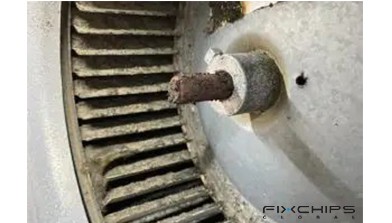
Slow Fan Speed:
▶ Cause: Weak capacitor, low supply voltage, or worn bearings.
▶ Solution: Check the capacitor, voltage, and mechanical parts.
Excessive Vibration:
▶ Cause: Unbalanced fan blade, loose mounting, or damaged bearing.
▶ Solution: Check blade balance, mounting, and shaft condition.
Frequent Power Trips:
▶ Cause: Shorted windings, electrical faults, or excessive current.
▶ Solution: Check the wiring, insulation, and motor current.
How to Test an AC Fan Motor
A multimeter can help check the electrical condition of an AC fan motor. Follow these steps to identify common electrical faults.
|
Step |
Description |
Tips |
|
1. Disconnect Power |
Turn off the power supply before testing the motor. |
Confirm that no voltage is present. |
|
2. Inspect the Motor |
Check the wires, terminals, and windings for visible damage. |
Look for burnt marks or loose connections. |
|
3. Set the Multimeter |
Set the multimeter to resistance (Ω) mode. |
Choose a suitable resistance range. |
|
4. Test Winding Resistance |
Place the probes on the motor winding terminals and measure resistance. |
OL may indicate an open winding; very low resistance may suggest a short. |
|
5. Check Ground Faults |
Measure resistance between each winding terminal and the metal motor frame. |
A low resistance reading may indicate an insulation fault. |
|
6. Test the Capacitor |
Disconnect one capacitor lead and select capacitance (µF) mode to measure its value. |
Compare the reading with the rated capacitance. |
|
7. Check the Results |
Compare all readings with the motor's wiring diagram and specifications. |
Abnormal readings may indicate a faulty winding or capacitor. |
How to Replace a Bad AC Fan Motor
Replacing an AC fan motor may require electrical and mechanical skills. Small fan motors may be easier to replace, but HVAC and industrial motors should be handled by qualified technicians.
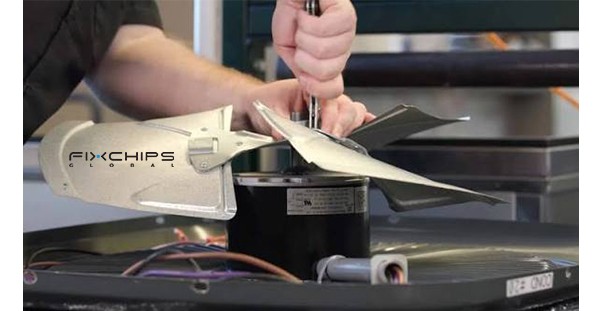
The basic replacement steps are:
1. Disconnect Power: Turn off the circuit breaker and confirm that the power is disconnected.
2. Access the Motor: Remove the fan cover or housing to reach the motor.
3. Record the Wiring: Take photos or label the wires before disconnecting them.
4. Remove the Old Motor: Disconnect the wires, remove the mounting screws, and carefully take out the motor.
5. Check the Replacement: Match the new motor's voltage, horsepower, speed, rotation direction, mounting size, and other required ratings.
6. Install the New Motor: Secure the replacement motor in the original mounting position.
7. Reconnect the Wiring: Connect the wires according to the wiring diagram and manufacturer instructions.
8. Reassemble the Fan: Reinstall the fan blades, housing, and protective covers.
9. Test the Motor: Restore power and check the rotation direction, airflow, noise, and normal operation.
Important: Never select a replacement motor based only on its physical size. Its electrical ratings and mechanical specifications must also match the equipment.
Advantages of Using AC Fan Motors
AC fan motors offer several benefits for residential, commercial, and industrial equipment. These advantages help improve airflow, equipment operation, and system performance.
- Simple Design: Many AC motors have a straightforward structure with fewer moving electrical parts.
- Reliable Operation: Induction motors have a simple rotor design and can operate for long periods with proper maintenance.
- Wide Power Range: AC motors are available in different power ratings for small fans and large industrial systems.
- Easy Power Supply: They can operate directly from suitable AC power sources without requiring a separate DC supply.
- Low Maintenance: Many induction motors do not use brushes, which reduces the need for brush replacement.
- Flexible Applications: Different motor types can meet the needs of ventilation, cooling, refrigeration, and air-conditioning systems.
- Energy-Saving Options: High-efficiency designs, such as ECM motors, can reduce electricity use while providing adjustable speed control.
Frequently Asked Questions
What is an AC fan motor?
An AC fan motor converts electrical energy into mechanical motion to drive fan blades. It moves air across the evaporator or condenser coils to support heat exchange and air circulation.
How do I know if an AC fan motor is failing?
An AC fan motor may be faulty if it does not start, runs slowly, makes unusual noises, or overheats. However, a bad capacitor or wiring problem can cause similar symptoms, so test these parts before replacing the motor.
Can I replace an AC fan motor myself?
Replacing an AC fan motor may be possible if you have the right tools and electrical skills. However, HVAC systems contain dangerous electrical components, so professional help is recommended if you are not trained to handle the wiring and installation.
How do I check an AC fan motor?
You can use a multimeter to measure winding resistance and check for open or shorted circuits. You should also inspect the motor shaft and test the capacitor, as these parts can cause similar problems.
What is the average lifespan of an AC fan motor?
An AC condenser fan motor typically lasts about 10–15 years. Its actual lifespan depends on operating hours, maintenance, installation quality, and working conditions.
Related Articles


