



Introduction
A variable resistor is a resistor whose resistance can be adjusted within a designed range. It is used to control current, adjust voltage, or change the behavior of a circuit.
This article explains its structure, working principle, main types, applications, advantages, disadvantages, and basic testing method.
What Is a Variable Resistor?
A variable resistor is an electronic component that allows its resistance to be changed. Unlike a fixed resistor, its resistance does not have to stay at one set value. Common types include rheostats, preset or trimmer resistors, digital variable resistors, and potentiometers.
Variable resistors are useful when a circuit needs adjustment after assembly or during normal operation. The adjustment can be made mechanically with a knob or screw, or electronically in a digital device.
Functions of Variable Resistors
A variable resistor can perform several important functions in a circuit:
- Current control: Changing the resistance changes the current flowing through the circuit when the supply voltage and other circuit conditions remain suitable.
- Voltage adjustment: A potentiometer can work as an adjustable voltage divider to provide a selected output voltage.
- Signal adjustment: Variable resistance can be used to adjust signal level or other circuit parameters.
- Circuit calibration: A variable resistor can help adjust a circuit to a required operating value during setup or testing.
Symbols of Variable Resistors
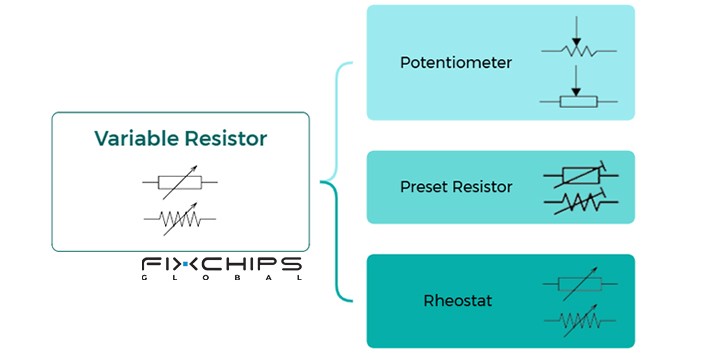
A variable resistor is commonly shown as a resistor symbol with an arrow pointing to the resistive element. The arrow represents the adjustable wiper.
Using a standard symbol makes the component easy to identify on a circuit diagram. It also shows that the resistance can be adjusted.
How Dose a Variable Resistor Work?
To understand how a variable resistor works, it is useful to first look at its basic internal structure.
Components of Variable Resistors
The exact structure depends on the type, but common parts include:
Resistive element: provides electrical resistance and forms the path through which current can flow.
Wiper: moves along the resistive element and selects a different point, changing the resistance between the selected terminals.
Terminals: the electrical connection points between the component and the external circuit.
Adjustment mechanism: A shaft, knob, screw, or electronic control changes the wiper position or selected resistance.
Housing: The outer body protects the internal parts and provides the mechanical mounting structure.
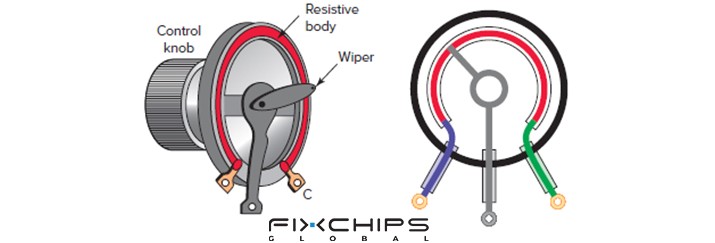
A basic two-terminal variable resistor uses the wiper and one end of the resistive element as its working terminals.
A potentiometer is a special type of variable resistor with three external terminals. Its wiper can divide the total resistance into two adjustable sections.
Digital variable resistors use electronic switches and a resistor network instead of a mechanical wiper. The resistance is selected by a digital control signal.
Working Principle of Variable Resistors
The basic working process can be understood through the following steps:
1. Apply the circuit voltage: The variable resistor is connected to the circuit so that current can flow through its resistive path.
2. Change the adjustment: The knob, shaft, screw, or digital control changes the selected point on the resistive element.
3. Change the resistance: The resistance between the selected terminals changes as the selected point moves.
4. Change the circuit response: The new resistance changes the current, voltage, signal level, or another circuit condition.
5. Reach the required setting: The adjustment stops when the circuit reaches the desired operating value.
Variable Resistor and Fixed Resistor Comparison
Variable resistors and fixed resistors both provide electrical resistance. The main difference is that a variable resistor allows its resistance to be adjusted, while a fixed resistor is designed to provide a set resistance value.
|
Criteria |
Variable Resistor |
Fixed Resistor |
|
Resistance Range |
1 kΩ, 10 kΩ, 50 kΩ, and 100 kΩ |
a few ohms to 1 MΩ or more |
|
Power Rating |
Common small potentiometers are around 0.05–0.25 W |
0.25 W (1/4 W) |
|
Resistive Material |
carbon, cermet, conductive plastic, and wire-wound |
metal film, carbon film, thick film, thin film, and wire-wound |
|
Cost |
higher in unit cost than simple fixed resistors |
lower in unit cost |
|
Applications |
volume, brightness, current, voltage, signal adjustment, and calibration |
current limiting, voltage division, biasing, and circuit protection |
Note: The values for power rating and cost are not the same for every product. The relevant datasheet should always be checked before selecting a component.
Types of Variable Resistors
Variable resistors can be classified by how their resistance is adjusted and how they are connected in a circuit. The main types include rheostats, preset or trimmer resistors, digital variable resistors, and potentiometers.
Rheostat
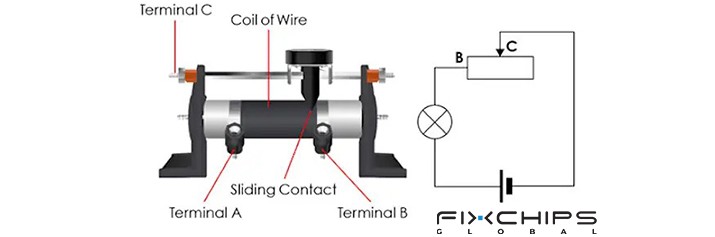
A rheostat is a two-terminal variable resistor used mainly to control current by changing the resistance in a circuit. It uses a resistive element and a movable contact, or wiper, to select the required resistance.
Rheostats are used where adjustable resistance is needed directly in the current path. Their applications include current adjustment and control circuits.
Preset or Trimmer Resistor
A preset or trimmer resistor is a small adjustable resistor designed mainly for setting or calibrating a circuit. It is normally adjusted during manufacturing, testing, or servicing rather than being changed frequently by the user.
A screw or similar adjustment mechanism changes the resistance. Trimmers are useful when a circuit needs a fixed setting after calibration.

Digital Variable Resistor (DVR)
A digital variable resistor changes its resistance through electronic control rather than a mechanical knob or shaft. It commonly uses a resistor network and electronic switches, with a digital code selecting the required resistance setting.
Digital variable resistors can be used for calibration, voltage adjustment, gain control, brightness control, and other electronically controlled functions. Their available resistance steps, voltage limits, current limits, and memory features depend on the specific device.

Potentiometer
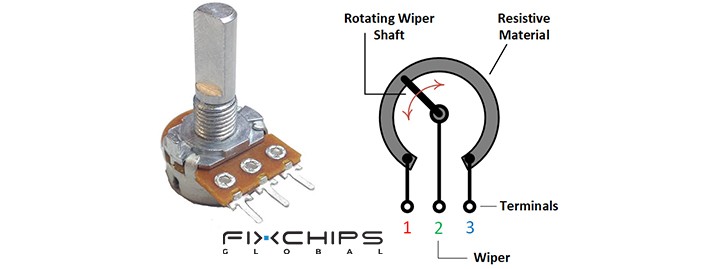
A potentiometer is a special type of variable resistor with three terminals: two connected to the ends of the resistive element and one connected to the movable wiper.
Unlike a basic two-terminal variable resistor, a potentiometer can use the wiper and both ends of the resistive element to form an adjustable voltage divider. This makes it useful for applications such as volume controls, brightness controls, and adjustable signal levels.
Rheostat vs Potentiometer
Rheostats and potentiometers are both common adjustable resistive components. However, they normally use different connection methods and perform different main functions.
|
Criteria |
Rheostat |
Potentiometer |
|
Number of Terminals |
2 terminals |
3 terminals |
|
Main Function |
Mainly controls current by changing resistance |
Mainly adjusts voltage or signal level |
|
Connection Type |
Uses the wiper and one end of the resistive element |
Uses the two ends and the wiper of the resistive element |
|
Adjustment Method |
Usually mechanical |
Usually mechanical |
|
Durability / Life Cycle |
Similar or lower in common mechanical designs |
Similar or higher in common mechanical designs |
|
Cost |
Usually lower for simple, low-power designs |
Usually higher because of the three-terminal structure and wider range of designs |
|
Applications |
Current adjustment, motor control, and variable resistance circuits |
Volume control, brightness control, voltage adjustment, and signal control |
Applications of Various Resistors
Variable resistors are used in many electronic products and control systems. By changing resistance, they can adjust current, voltage, signal level, or other circuit parameters.
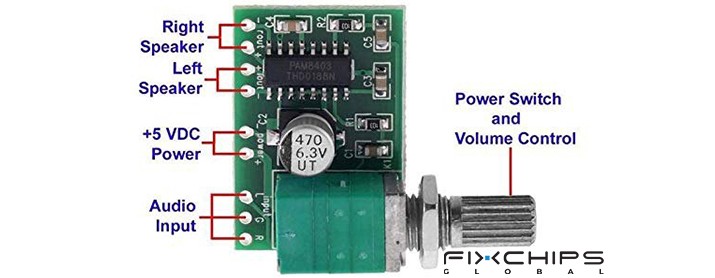
- Audio equipment: In speakers, amplifiers, and audio mixers, a potentiometer can change the signal level to adjust volume.
- Lighting products: In dimmer controls and some lighting systems, a variable resistor can change the control voltage or current, which can adjust light brightness when the circuit is designed for this function.
- Home appliances: In appliances such as fans and heaters, variable resistance can change the control signal or current, helping adjust operating levels in suitable control circuits.
- Motor control systems: In some motor control circuits, a rheostat can change the current or control input, which can affect motor operating conditions such as speed.
- Electronic instruments: In test and measurement equipment, a variable resistor can change a calibration value or reference voltage, helping set the circuit to the required operating point.
- Consumer electronics: In products such as radios and control panels, potentiometers can change signal levels or control voltages, allowing users to adjust settings.
- Electronic circuit boards: Trimmer resistors can change a resistance value during calibration, allowing engineers or technicians to fine-tune the circuit after assembly.
Pros and Cons of Variable Resistors
Advantages
- Adjustable resistance: The resistance can be changed to match different circuit requirements.
- Easy circuit adjustment: Designers can fine-tune a circuit without replacing the entire resistor.
- Useful for user controls: Potentiometers provide a simple way for users to adjust settings such as volume.
- Supports calibration: Trimmer resistors can help compensate for differences between circuit components.
Disadvantages
- Mechanical wear: Mechanical types contain moving parts that can wear with repeated adjustment.
- Limited power handling: The allowed power, voltage, and current depend on the specific component.
- Adjustment accuracy varies: Mechanical adjustment may not provide the same setting resolution as a digitally controlled device.
How to Test a Variable Resistor?
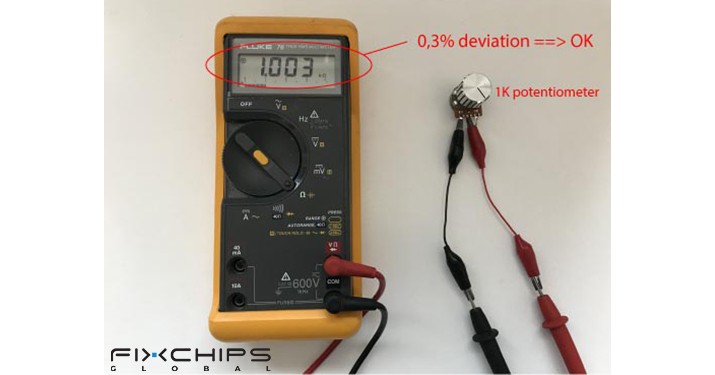
Before testing, turn off the circuit power. If possible, disconnect the variable resistor from the circuit or isolate the relevant terminals. This helps prevent other circuit components from affecting the resistance reading.
|
Steps |
Description |
Tips |
|
1. Power Off |
Turn off the circuit before measuring resistance. |
Never measure resistance on a powered circuit. |
|
2. Select Ω Mode |
Set the multimeter to resistance mode. |
Choose a suitable resistance range if the meter is not automatic. |
|
3. Connect Leads |
Connect the meter to the required terminals of the variable resistor. |
For a two-terminal test, measure between the selected working terminals. |
|
4. Check Initial Value |
Read the resistance shown by the meter. |
Compare the reading with the expected value or component specification. |
|
5. Adjust |
Slowly turn the knob or adjustment screw. |
Change the setting gradually and watch the resistance reading. |
|
6. Check the Change |
Confirm that the resistance changes as the adjustment is moved. |
A sudden jump or unstable reading may indicate a problem. |
|
7. Check Full Range |
Move through the available adjustment range when appropriate. |
Do not force the adjustment mechanism past its designed limit. |
Frequently Asked Questions
What is a variable resistor?
A variable resistor is a resistor with an adjustable resistance value. It can control current, voltage, or signal levels in a circuit.
What are variable resistors also called?
Variable resistors can include potentiometers, rheostats, and trimmer resistors. These types are used in different ways to adjust resistance in a circuit.
How does a variable resistor work?
A mechanical variable resistor changes resistance when its wiper moves along the resistive element. This changes the resistance in the circuit and controls current or voltage.
What is the usual life of a variable resistor?
The service life depends on its type, material, and how often it is adjusted. Many mechanical types are rated by the number of adjustment cycles they can handle.
Can variable resistors handle high power?
Yes, some variable resistors are designed for high-power use. Wire-wound types are often used when higher power handling is needed, but the rated power must be checked before use.


